키프로스는 지중해 동부의 섬나라이자 유럽 연합의 회원국입니다. 2004. 경제는 관광을 기반으로 합니다., 해운, professional services, and a sustained construction boom — is concentrated almost entirely along a narrow coastal strip, which means the country’s most valuable concrete sits within a few hundred meters of the sea. Salt-laden spray, chloride-bearing groundwater, long hot summers, and a coastline crowded with marinas, 항구, desalination plants, and high-rise towers combine to make coastal durability the defining engineering problem of Cypriot construction. The additive that has become central to solving it is 마이크로실리카, 실리카흄이라고도 함.
This article explains why Cyprus’s marine climate and infrastructure pipeline create such specific demands for high-performance concrete, how microsilica meets those demands at the microstructural level, and how HSA Microsilica supports contractors, ready-mix producers, and engineering firms working across this fast-moving EU market.
Cyprus’s Coastal and Infrastructure Landscape
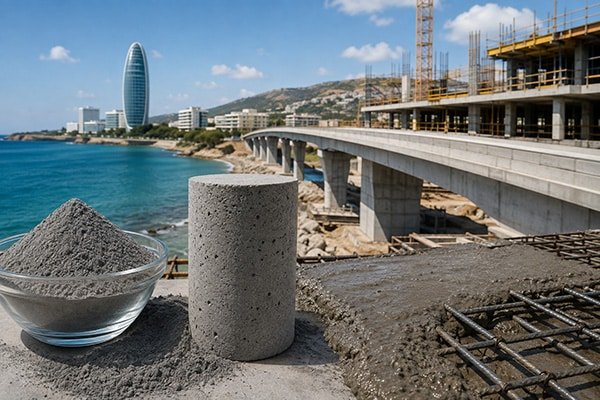
Cyprus is defined by its sea. 이상으로 700 km of coastline and a hot semi-arid climate, the island experiences intense summer heat, high ultraviolet exposure, and persistent airborne chlorides that drift inland from the Mediterranean. Coastal structures are continuously bathed in a marine aerosol, while groundwater in many areas is mineral-rich and aggressive toward ordinary Portland-cement concrete. For reinforced concrete, the threat is concrete cancer by another name: chloride ions penetrate the cover, reach the reinforcing steel, break down its passive oxide film, and trigger corrosion that spalls the concrete and shortens structural life. This is not a hypothetical risk in Cyprus — it is the single most common cause of deterioration in its coastal and waterfront assets.
The project pipeline only sharpens the requirement. Coastal development continues to concentrate around marinas such as Limassol and Ayia Napa, port expansions at Limassol and Larnaca, and a wave of high-rise residential and commercial towers reshaping the Limassol skyline. On the water side, Cyprus now sources the large majority of its drinking water from desalination — its permanent units produce well over 235,000 m³ per day, covering roughly 70–80% of potable demand — and a €1.2 billion National Water Works Investment Plan aims to roughly double capacity toward 400,000 m³ per day by the end of the decade, adding new plants at Limassol port, Vasiliko, Episkopi, Mazotos, and elsewhere. Every one of these assets — intake and outfall structures, concrete tanks, pump stations, quay walls, and coastal towers — must resist chloride attack, high water pressure, and aggressive groundwater for decades with minimal intervention.
Why Coastal Concrete in Cyprus Needs Microsilica
Microsilica is an ultra-fine amorphous silicon dioxide (SiO2) recovered from the off-gases of silicon and ferrosilicon smelting. Its particles are roughly 100 시멘트 곡물보다 작은 시간, and this extreme fineness gives it two reinforcing mechanisms in concrete. 첫 번째, a physical micro-filling effect: the tiny particles pack into the voids between cement grains, densifying the paste. Second, ㅏ pozzolanic reaction: microsilica reacts with the calcium hydroxide released during cement hydration to form additional calcium silicate hydrate (C-S-H), the very compound that gives concrete its strength and binds the matrix together.
The combined result is a hardened paste with a far finer, less interconnected capillary pore network — and therefore dramatically lower permeability. This is why microsilica is a core ingredient in ultra-high-performance concrete (UHPC), and why it is the most effective single addition available to a mix designer trying to keep chlorides out of the cover zone of a marine structure. Lower permeability means slower chloride ingress, longer time to corrosion initiation, and a longer service life for the same concrete cover.
How Microsilica Solves Cyprus’s Core Concrete Challenges
1. Chloride Resistance Against Salt Spray and Seawater
The primary threat to coastal reinforced concrete is chloride penetration. 기공 구조를 정제함으로써, microsilica sharply reduces the rate at which chloride ions migrate through the concrete cover to the steel. This is the single most valuable property for Cypriot marine and waterfront structures, and it is a well-documented mechanism in the guidance literature on marine durability. For a deeper look at how microsilica extends concrete life, see our explainer on the effect of microsilica on the durability of concrete.
2. Watertightness for Desalination and Water Infrastructure
Desalination plants, storage reservoirs, and coastal intake structures demand concrete that holds back both seawater and high-pressure potable water without leaking or deteriorating. The densified paste that microsilica produces dramatically lowers permeability, producing watertight structures that resist seepage. This is the same property leveraged in silica fume for waterproofing 응용 프로그램, and it matters acutely in a country that now depends on desalination for most of its drinking water.
3. High Compressive Strength for High-Rise and Long-Span Structures
Limassol’s waterfront towers and the island’s bridges and marine decks need concrete that can carry heavy structural loads while standing up to a marine environment. Microsilica reliably pushes compressive strength well beyond the reach of ordinary mixes, which is why it anchors 고강도 콘크리트의 실리카 흄. Higher strength also allows slimmer columns and lighter structures on coastal sites where land is scarce and wind and seismic loads govern the design.
4. Sulfate Resistance Against Aggressive Groundwater
Much of Cyprus’s groundwater and coastal subsoil is sulfate-bearing, and sulfate attack gradually degrades the cement paste of foundations, piles, and buried structures. The dense, low-permeability matrix produced by microsilica resists sulfate ingress and chemical deterioration far better than ordinary Portland-cement paste, protecting foundations, retaining walls, and marine substructures from aggressive ground conditions.
5. Extended Service Life and Lower Maintenance
The economics of a desalination plant, a quay wall, or a coastal tower are dominated by the cost of keeping it standing, not just the cost of pouring it. Because microsilica slows chloride ingress, carbonation, and sulfate attack, it extends the time to first major repair and cuts whole-life maintenance. For bridge decks and marine decks subjected to chlorides, this is the logic behind silica fume for bridge deck overlays, where a durable, low-permeability overlay is the cheapest way to protect the deck below.
Where Cyprus Projects Are Applying Microsilica
| 신청 | Cyprus Context | Key Microsilica Benefit |
|---|---|---|
| Desalination intake/outfall and process structures | Permanent and new mobile units at Limassol port, Vasiliko, Episkopi, Mazotos | Watertightness, chloride and sulfate resistance |
| Marina quay walls, pontoons, and breakwaters | Limassol Marina, Ayia Napa Marina, Larnaca redevelopment | Seawater durability, 낮은 투자율, long life |
| Coastal high-rise towers | Limassol waterfront residential and commercial towers | 고강도, reduced cover, chloride resistance |
| Port and marine structures | Limassol and Larnaca port expansions | Abrasion and chloride resistance, 내구성 |
| Bridge decks and coastal road infrastructure | Motorway network and marine crossings | Low-permeability overlays, sulfate resistance |
| Precast pipes, 배수로, and marine elements | Precast yards supplying water and coastal projects | High early strength, faster mold turnover |
Best Practices for Specifying Microsilica in Cypriot Projects
- Dose against exposure, not just strength. In a marine environment, specify the dosage needed to hit the required chloride-permeability class first (commonly 5–10% of cementitious material by weight), then confirm compressive strength.
- Match the grade to the application. Undensified microsilica disperses readily in wet-mix and ready-mix production, while densified grades suit bulk handling, lower dust, and larger batching plants — choose the form that fits the site and mixing equipment.
- Pair with a high-range water reducer. Microsilica’s high surface area raises water demand; a compatible superplasticizer keeps the mix workable while preserving the low water-cement ratio that chloride resistance depends on.
- Verify conformity against European standards. As an EU member, Cyprus adopts European norms — concrete under CYS EN 206 and silica fume under CYS EN 13263. Request certificates of analysis covering SiO₂ content, 훌륭함, and pozzolanic activity index, and align with the national technical committees overseen by the Cyprus Organisation for Standardisation (CYS).
- Protect the cover and cure properly. Marine structures live or die by their concrete cover to the reinforcement; specify adequate cover, and follow marine-durability curing guidance such as that published by the American Concrete Institute to ensure the densified paste actually reaches its design impermeability.
자주 묻는 질문
Why is microsilica preferred over ordinary admixtures for marine concrete in Cyprus?
Microsilica addresses the defining failure mode of coastal concrete — chloride-induced corrosion of the reinforcement — by physically densifying the paste and reacting pozzolanically to close off the capillary pores. Few other additions reduce chloride permeability, increase strength, and improve watertightness in a single material the way microsilica does.
Is microsilica suitable for desalination plant concrete that contacts seawater and brine?
예. The low permeability and chemical resistance of microsilica concrete make it well suited to intake, outfall, and process structures exposed to seawater and concentrated brine, where watertightness and resistance to chloride and sulfate attack are essential over a long service life.
How does microsilica protect reinforcing steel from chloride attack?
Microsilica refines the capillary pore structure of the hardened paste, dramatically slowing the rate at which chloride ions migrate through the concrete cover. This delays the moment when chlorides reach the steel and break down its protective oxide film, extending the time to corrosion initiation and the overall service life.
Does adding microsilica significantly raise the cost of a coastal project?
Material cost per cubic meter rises modestly, but the savings from a longer-lasting, lower-maintenance structure usually dominate over the asset’s life — especially for marine and water infrastructure where repair access is difficult, disruptive, and expensive, and where premature deterioration can threaten water supply continuity.
Can HSA Microsilica supply microsilica into Cyprus reliably?
예. Cyprus is well connected through the ports of Limassol and Larnaca and the wider eastern Mediterranean shipping lanes, and HSA Microsilica ships densified and undensified grades in bulk bags and containers into the region with full documentation, supporting desalination, 선박, and high-rise construction programs.
About HSA Microsilica
HSA Microsilica is a specialized manufacturer and global supplier of silica fume, densified and undensified microsilica, and related pozzolanic materials for the concrete, 선박, 내화 물질, and construction chemicals industries. With rigorous quality control and export experience across Europe, 중동, the Americas, and Asia-Pacific, HSA Microsilica supports engineers and contractors working under CYS EN 206, ASTM C1240, and other international standards. Our team understands the technical demands of coastal and marine construction — from chloride resistance and waterproofing to high-strength and precast production — and provides full documentation, including certificates of analysis and pozzolanic activity data, with every shipment.
For contractors, ready-mix producers, and engineering firms sourcing microsilica for desalination, marina, port, or high-rise projects in Cyprus and the wider eastern Mediterranean, HSA Microsilica offers both densified and undensified grades suited to ready-mix, 선박, and precast applications. Contact our technical sales team to discuss mix design support, bulk pricing, and shipment scheduling for your next project.