Сертификация зеленого строительства превратилась из нишевого стремления в основное требование к закупкам. LEED — Лидерство в энергетическом и экологическом проектировании — остается наиболее широко распространенной в мире системой., с более чем 100,000 сертифицированные проекты по всему миру 180 страны. Для владельцев, разработчики, и проектные команды, проходящие сертификацию LEED, каждое существенное решение имеет определенные последствия, и совокупный эффект этих решений определяет, достигнет ли проект сертифицированного уровня., Серебро, Золото, или Платиновый статус.
Конкретный, как самый потребляемый строительный материал на Земле, находится в центре любой серьезной стратегии использования материалов LEED. И внутри бетонной смеси, микрокремнезем, также называемый микрокремнеземом или конденсированным микрокремнеземом, является одной из немногих отдельных примесей, способных внести значимый вклад в несколько кредитных категорий LEED одновременно.. Understanding precisely how it does so is essential knowledge for sustainability-conscious engineers, specifiers, and project managers.
What is LEED and how does it score materials?
LEED v4 and v4.1, the current operative versions, assess buildings across eight credit categories: Location and Transportation, Sustainable Sites, Water Efficiency, Energy and Atmosphere, Materials and Resources, Indoor Environmental Quality, Innovation, and Regional Priority. For most structural and envelope materials, the relevant categories are Materials and Resources (MR) а также, increasingly, the whole-building life-cycle assessment credits that span Energy and Materials.
Within Materials and Resources, LEED v4.1 places particular emphasis on four pathways: Environmental Product Declarations (EPDs), sourcing of raw materials, material ingredient reporting, and — most relevant to microsilica — the recycled content and low-embodied-carbon credentials of structural materials. Projects earn points by documenting that a threshold proportion of their materials (by cost) meet defined sustainability criteria.
Microsilica as a recovered industrial byproduct
The most direct LEED contribution of microsilica comes through its classification as a recovered industrial byproduct. Microsilica is generated as a co-product of silicon metal and ferrosilicon alloy production in electric arc furnaces. Without collection and beneficial use, it would be classified as an industrial waste requiring disposal. Its diversion into concrete applications is a textbook example of industrial symbiosis — one industry’s waste stream becoming another’s high-value input.
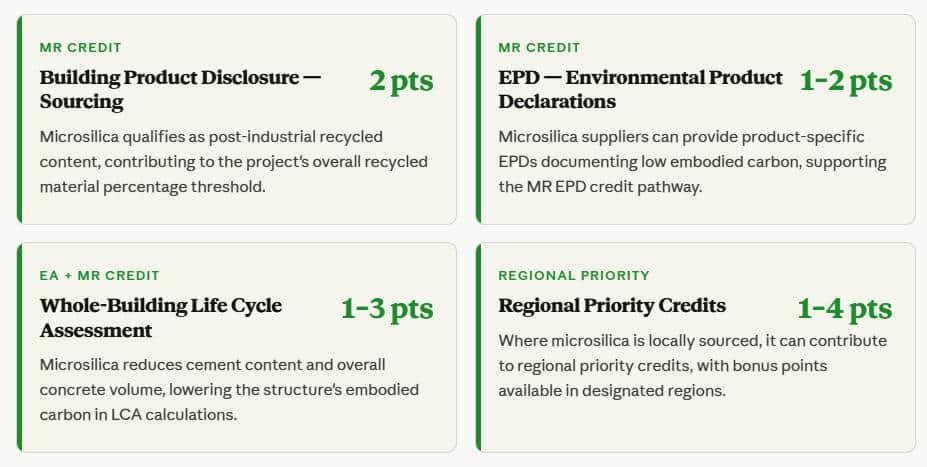
Under LEED v4.1’s MR Credit: Building Product Disclosure and Optimization – Sourcing of Raw Materials, materials that are derived from recycled or reclaimed sources contribute toward the project’s recycled content percentage. Microsilica qualifies as a post-industrial recycled material, and its use in concrete mix designs contributes to the project’s overall recycled content calculation. When microsilica is used at 10–25% by mass of cementitious materials — a typical range for высокопрочный бетон — its contribution to the concrete’s recycled content by weight is straightforward to document and verify.
Reducing cement content — and embodied carbon
Perhaps the most significant, if less immediately obvious, LEED contribution of microsilica lies in what it allows engineers to remove from the mix rather than what it adds. Portland cement clinker carries one of the highest embodied carbon intensities of any construction material — approximately 0.83 kg CO₂ per kilogram of clinker produced, primarily from the calcination of limestone and the fuel combustion required to reach kiln temperatures of 1,450°C. Globally, cement production is responsible for approximately 7–8% of all anthropogenic CO₂ emissions.
микрокремнезем is a highly efficient cement replacement. Because it reacts pozzolanically with calcium hydroxide released during cement hydration — converting it into additional calcium silicate hydrate (C-S-H) gel — it can replace Portland cement on a less-than-equal mass basis and still achieve equal or superior strength outcomes. На практике, а 10% replacement of cement by microsilica in a high-performance concrete mix reduces the cement content by 10% while maintaining or improving compressive strength, долговечность, и непроницаемость. This translates directly into a proportional reduction in the concrete’s embodied carbon footprint.
Every kilogram of Portland cement replaced by microsilica removes approximately 0.83 kg of CO₂ from the concrete’s embodied carbon inventory — at no cost to structural performance, and often with a measurable improvement in durability.
In the context of LEED’s whole-building life-cycle assessment (LCA) credit, this embodied carbon reduction is quantifiable and documentable. Projects that use microsilica-enhanced concrete mixes can demonstrate lower global warming potential (GWP) for their structural system compared to a conventional concrete baseline, directly supporting the LCA credit under LEED v4.1 Materials and Resources.
Долговечность, service life, and lifecycle carbon
LEED’s environmental accounting does not stop at the construction phase. Increasingly, certification frameworks — including LEED v4.1 and the emerging ISO 21930 framework — consider whole-life carbon, which includes operational energy, обслуживание, and end-of-life impacts. Здесь, microsilica’s extraordinary durability contribution becomes a sustainability multiplier.
The dense, low-permeability microstructure produced by pozzolanic reaction with microsilica dramatically reduces chloride ion penetration, carbonation depth, and water absorption — the three primary pathways through which concrete deteriorates and requires repair or replacement. A microsilica-enhanced structural concrete element that achieves a service life of 100 years instead of 60 years embodies, per year of service, грубо 40% less material production impact. When this extended service life is incorporated into a whole-building LCA, the environmental benefit of microsilica compounds significantly beyond the initial embodied carbon reduction.
Качество окружающей среды в помещении: менее известное преимущество
Вклад Microsilica в качество окружающей среды в помещениях LEED (IEQ) категория косвенная, но реальная. За счет значительного снижения проницаемости бетона, Бетонные полы и стены, усиленные микрокремнеземом, имеют более низкие показатели выделения паров влаги. (МВЭР) — критический параметр для совместимости клея для напольных покрытий и качества воздуха в помещении.. Высокий MVER обычных бетонных плит является основной причиной отказов системы перекрытия., клей, выделяющий газы, и риск роста плесени. Использование микрокремнезема в конструкциях с плитами и фальшполами способствует созданию подложки с более низкой проницаемостью, что снижает долгосрочные риски IEQ., поддержка способности проектной команды демонстрировать здоровую внутреннюю среду.
Путь ЭПД: документирование экологического профиля микрокремнезема
Environmental Product Declarations (EPDs) являются документальной валютой кредитов материалов LEED. EPD – это стандартизированный документ., проверенный третьей стороной отчет, который количественно определяет воздействие продукта на окружающую среду на протяжении всего его жизненного цикла — от добычи сырья до производства., использовать, и конец жизни — выраженный в показателях, включая потенциал глобального потепления, разрушение озона, подкисление, и эвтрофикация.
Under LEED v4.1’s MR Credit: Раскрытие информации и оптимизация продукции – экологические декларации продукции, проекты зарабатывают баллы, когда определенная доля продуктов (by cost) иметь EPD в наличии. Производители микрокремнезема, получившие EPD для конкретного продукта, а не средние по отрасли EPD, предоставляют проектным группам наиболее точную и защищенную документацию.. EPD для конкретного продукта для микрокремнезема постоянно демонстрируют очень низкий профиль содержания углерода по сравнению с вкладом материала в структурные характеристики., что делает его одним из наиболее подходящих материалов для включения в кредитный портфель MR проекта LEED..
| Кредит LEED v4.1 | Категория | Вклад микрокремнезема | Потенциальные очки |
|---|---|---|---|
| EPD — Раскрытие информации о продукции | MR | Доступен EPD для конкретного продукта | До 2 баллы |
| Источники — переработанный контент | MR | Постиндустриальный переработанный побочный продукт | До 2 баллы |
| LCA всего здания | MR | Снижает структурный ПГП по сравнению с базовым уровнем | До 3 баллы |
| Региональный приоритет | РП | Микрокремнезем местного производства | До 4 баллы |
| Инновационный кредит | В | Образцовая производительность в переработанном контенте | 1 пт |
| Крытый Env. Качество (косвенный) | IEQ | Low MVER, reduced mold/off-gas risk | Supporting |
Practical guidance for LEED project teams
For project teams actively pursuing LEED certification, integrating microsilica into the concrete specification is one of the highest-value material decisions available. The pathway is straightforward: specify microsilica at 10–15% by cementitious mass for standard HPC applications, or 20–25% for UHPC, request full EPD and recycled content documentation from your supplier, and ensure your structural engineer of record updates the mix design to reflect the cement replacement and verify compliance with ACI 318 or equivalent structural code requirements.
The documentation burden is modest compared to the credit returns. A single material substitution — replacing a portion of Portland cement with a verified, Порошок микрокремнезема на основе EPD — может разблокировать вклады по трем или более кредитным категориям LEED., поддерживать измеримое сокращение жизненного цикла выбросов углерода в рамках проекта, и создать более прочную конструкцию, которая будет работать лучше на протяжении всего срока службы.. В системе сертификации, где важен каждый балл и где разрыв между серебром и золотом часто устраняется тщательной спецификацией материалов., микрокремнезем заслуживает заметного места в конкретной стратегии каждого проекта LEED..
Готовый к LEED порошок микрокремнезема, документально подтверждено и сертифицировано на экспорт
Компания Henan Superior Abrasives поставляет высокочистый уплотненный и неуплотненный порошок кремнезема для проектов зеленого строительства и производителей бетона в 30+ страны. Наша продукция полностью соответствует стандартам ASTM C1240 и EN. 13263, and we provide complete technical documentation packages — including EPD support, certificate of conformance, recycled content declarations, and country of origin certification — to support your LEED credit submissions.