Chloride content is one of the most consequential — and most underexamined — parameters on a silica fume Certificate of Analysis. While buyers routinely scrutinise SiO₂ purity, ลอย, และดัชนีกิจกรรมความแข็งแกร่ง, chloride ion (Cl⁻) content is often treated as a secondary concern. For many applications, that oversight carries real risk: elevated chloride in silica fume contributes to reinforcement corrosion, compromises durability in prestressed and post-tensioned structures, and disqualifies material from projects with strict specification limits.
Why Is Chloride Content Elevated in Standard Silica Fume?
To understand why chloride ends up in silica fume, it is necessary to understand the production process. Silica fume is a byproduct of smelting silicon metal and ferrosilicon alloys in electric arc furnaces at temperatures exceeding 2,000°C. The primary goal of the smelting operation is to produce a metallurgical-grade alloy that meets the purchaser’s specification for silicon content, impurity profile, and physical characteristics.
To achieve this goal, ferrosilicon producers add a range of additives to the furnace charge during smelting. These additives serve several purposes:
- Improving slag fluidity: Chloride-containing compounds lower slag viscosity, making it easier to tap and reducing furnace downtime.
- Controlling alloy composition: Certain additives help refine the distribution of silicon and iron in the melt, improving alloy consistency.
- Enhancing furnace efficiency: Some additives reduce energy consumption per tonne of alloy produced by optimising the thermodynamic conditions in the furnace.
- Removing impurities: Chloride-based fluxes help volatilise and remove certain metallic impurities from the melt, improving alloy purity.
The problem is that chloride-containing additives — including compounds such as calcium chloride and iron chloride — are volatile at electric arc furnace temperatures. As they decompose and evaporate, the resulting chloride-rich gases mix with the silicon dioxide fume rising from the furnace. When this fume is captured in the baghouse filtration system and processed into silica fume powder, the chloride compounds are carried along with the SiO₂ particles and remain in the finished product.
The result is that a significant proportion of commercially available silica fume — particularly material produced from ferrosilicon rather than pure silicon smelting — carries elevated chloride content that reflects the smelting chemistry of the alloy production process, not the silica fume itself. The silica fume is, in a sense, collateral to a metallurgical operation optimised for alloy quality rather than byproduct purity.
What Are the Risks of High Chloride in Silica Fume?
Reinforcement Corrosion
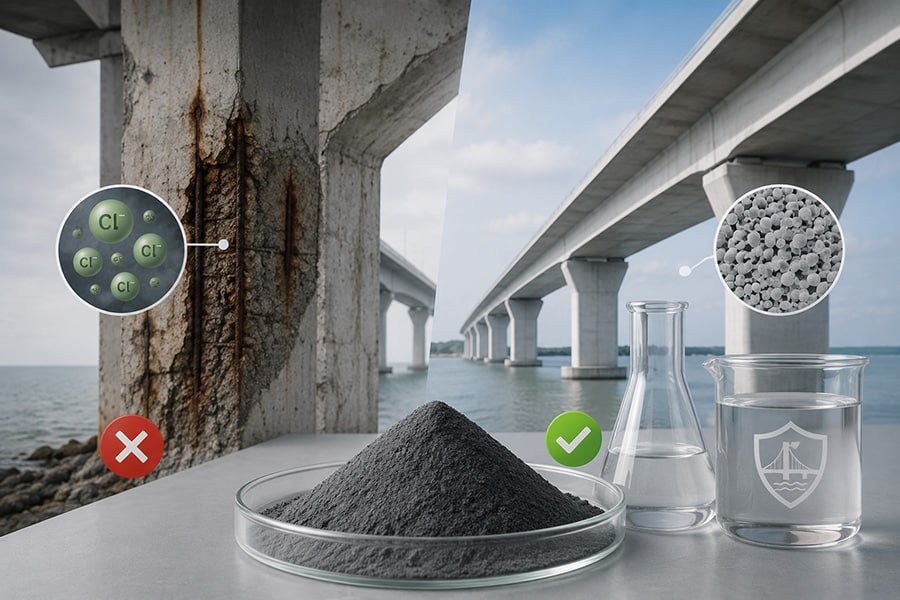
Chloride ions are the primary cause of depassivation of steel reinforcement in concrete. When chloride concentration at the steel surface exceeds a threshold value — typically around 0.4% by mass of cement — the passive oxide film protecting the reinforcement breaks down, initiating active corrosion. The resulting corrosion products expand, generating tensile stresses that cause concrete cracking, delamination, and spalling.
While silica fume is often used precisely to improve chloride resistance — by reducing concrete permeability and slowing chloride ingress from external sources — adding silica fume that itself contains elevated chloride partially undermines this benefit. The chloride contributed by the silica fume is introduced directly into the concrete matrix during mixing, bypassing the transport barrier that the dense silica fume paste is intended to provide.
Prestressed and Post-Tensioned Structures
The risk is most acute in prestressed and post-tensioned concrete, where high-strength steel tendons are under sustained tensile stress. Stress corrosion cracking can initiate at chloride levels well below those that would cause problems in conventional reinforced concrete. สำหรับเหตุผลนี้, many national codes and project specifications set strict limits on the total chloride content of all concrete constituents — including admixtures and supplementary cementitious materials.
In Europe, ใน 206 limits total chloride content of concrete to 0.20% by mass of cement for prestressed concrete. Where silica fume contributes a meaningful share of the binder content, even moderately elevated Cl⁻ in the silica fume can push total concrete chloride close to or above the permitted threshold.
Marine and Aggressive Environments
For structures in coastal and marine environments — precisely the applications where silica fume is most commonly specified — chloride management is critical across all concrete constituents. Mix designs for splash and tidal zone concrete are typically engineered to the tightest possible chloride limits. Silica fume with high intrinsic chloride content adds an unnecessary burden to an already tightly controlled system.
การใช้งานวัสดุทนไฟ
In refractory castables and monolithic linings, chloride content affects high-temperature chemical stability. At service temperatures above 800°C, chloride compounds can volatilise and react with refractory oxides, compromising the integrity of the lining. มีความสุขสูง, low-chloride silica fume is therefore preferred — and in some formulations required — for demanding refractory applications in steel, ปูนซีเมนต์, and glass furnaces. For more on the technical requirements of silica fume in these settings, ดูคำแนะนำของเรา ซิลิกาฟูมสำหรับการใช้งานวัสดุทนไฟ.
การประสานบ่อน้ำมัน
Silica fume used in oil well cement slurries must meet tight chloride limits because downhole environments expose steel casing to sustained pressure and temperature conditions where corrosion is difficult to remediate. Operators and cementing service companies typically specify Cl⁻ content well below EN 13263 limits for this reason.
What Do the Standards Say About Chloride Limits?
| มาตรฐาน / ข้อมูลจำเพาะ | Chloride Limit (Cl⁻) | Notes |
|---|---|---|
| ใน 13263-1 (ยุโรป) | ≤ 0.3% | Mandatory requirement; ASTM C1240 does not specify a Cl⁻ limit |
| ใน 206 (Prestressed concrete) | Total concrete Cl⁻ ≤ 0.20% โดยมวลของซีเมนต์ | All constituents including silica fume contribute to this limit |
| Typical project specification (มารีน) | ≤ 0.10% | Stricter than EN 13263; common for coastal infrastructure projects |
| วัสดุทนไฟ / ทางอุตสาหกรรม | ≤ 0.05% | Application-dependent; may be specified by end-user formulation requirement |
| Oil well cementing | ≤ 0.05% | Downhole corrosion management requirement |
It is worth noting that ASTM C1240 does not set a specific chloride limit for silica fume — a gap that is increasingly recognised as a weakness of the standard for projects where chloride management is critical. ใน 13263 is the more comprehensive reference for chloride control. For a full explanation of the differences between these two standards, see our guide on understanding BS EN 13263 silica fume standards.
HSA Low Chloride Silica Fume: Product Overview
HSA เป็นหนึ่งในซัพพลายเออร์ซิลิกาฟูมที่ใหญ่ที่สุดในประเทศจีน, and we supply low-chloride silica fume for buyers whose projects require chloride content significantly below standard industry levels. Our low-chloride grades are available with SiO₂ content of 98% and above — combining high purity with tightly controlled impurity levels across all parameters.
Why HSA’s Low-Cl Silica Fume Is Different
The key to low chloride content in silica fume lies in the selection of raw material source. Not all silica fume production routes result in the same chloride profile. Silica fume derived from the smelting of high-purity silicon metal — as opposed to ferrosilicon — tends to carry lower baseline chloride because the alloy quality requirements for pure silicon production place less reliance on chloride-bearing fluxing additives.
HSA’s high-purity, low-chloride silica fume is sourced from selected production streams with controlled additive usage, and is subject to additional quality screening to verify chloride content at batch level before shipment. Every shipment is accompanied by a batch-specific COA confirming Cl⁻ content — not a generic typical analysis. For context on what a robust silica fume testing programme looks like, refer to our complete guide to silica fume testing.
Product Specifications
| พารามิเตอร์ | Low-Cl Silica Fume (HSA) | Standard Commercial Silica Fume |
|---|---|---|
| เนื้อหา SiO₂ | ≥ 98% | 85% – 96% |
| Chloride Content (Cl⁻) | Well below EN 13263 limit (confirmed per batch COA) | จนถึง 0.3% (ใน 13263 maximum) |
| ขาดทุนจากการจุดระเบิด (ลอย) | ≤ 3.0% | ≤ 4.0–6.0% |
| ความชื้น | ≤ 3.0% | ≤ 3.0% |
| Physical Form | Densified or undensified powder | Densified or undensified powder |
| การปฏิบัติตามมาตรฐาน | ASTM C1240, ใน 13263 | ASTM C1240, ใน 13263 |
| บรรจุภัณฑ์ | 1,000 ถุงจัมโบ้ / 25 กระสอบกระดาษกก | 1,000 ถุงจัมโบ้ / 25 กระสอบกระดาษกก |
| ขั้นต่ำ | One 20-foot container (~20 tonnes) | One 20-foot container (~20 tonnes) |
Specific Cl⁻ values vary by production batch and are confirmed on the COA supplied with each shipment. Buyers with defined project chloride limits are encouraged to contact our technical team to discuss whether our current stock meets their specification before placing an order.
Applications Where Low-Cl Silica Fume Is Specified
- Prestressed and post-tensioned concrete: Where total mix chloride must remain within EN 206 or project-specific limits.
- Marine and coastal infrastructure: สะพาน, wharves, sea walls, and coastal buildings where chloride management across all mix constituents is essential.
- UHPC and reactive powder concrete: High-specification mix designs where every constituent is tightly controlled for purity and consistency.
- Refractory castables and industrial linings: High-temperature applications where chloride volatilisation at service temperatures can compromise lining integrity.
- Oil well and geothermal cementing: Downhole applications with strict corrosion management requirements.
- Nuclear and critical infrastructure: Projects with the highest documentation and traceability standards for all concrete constituents.
For a broader understanding of how silica fume quality parameters — including chloride content — affect concrete performance, ดูบทความของเราเกี่ยวกับ ผลของซิลิกาฟูมต่อคุณสมบัติของคอนกรีต.
Case Study: Coastal Bridge Project in Northern Europe
A precast concrete manufacturer producing box girder elements for a coastal bridge project in Northern Europe had specified silica fume at 10% cement replacement. The project specification required total concrete chloride content not to exceed 0.15% โดยมวลของซีเมนต์, with all constituent materials required to demonstrate Cl⁻ content on a batch-specific COA.
Their existing silica fume supplier was unable to consistently provide Cl⁻ values below 0.15% on individual batches — meaning the contribution of silica fume alone was pushing total mix chloride toward the project limit, leaving almost no margin for chloride from other sources including aggregates and mix water.
After switching to HSA’s low-chloride 98% SiO₂ silica fume, the manufacturer’s technical team confirmed that the silica fume contribution to total concrete chloride was reduced substantially, restoring the necessary margin within the project specification and eliminating the risk of non-conformance on the chloride parameter. Batch-specific COAs with confirmed Cl⁻ values were accepted by the project’s independent inspection authority without further qualification.
How to Order Low-Cl Silica Fume from HSA
- Contact our export team with your project chloride limit, required grade (เนื้อหาsio₂), physical form (densified or undensified), and estimated volume.
- Receive a sample and pre-shipment COA confirming SiO₂ and Cl⁻ content of available stock for your review.
- Confirm suitability against your project specification or pass the sample to your testing laboratory.
- Place your order — minimum one 20-foot container, ประมาณ 20 ตัน. Packaging in 1,000 kg jumbo bags or 25 กระสอบกระดาษกก.
Our team is available to provide technical consultation throughout the process. To request a sample or quote, เยี่ยมชมของเรา หน้าการติดต่อ or reach out directly by email or WhatsApp.
เกี่ยวกับ Henan Superior Abrasives (HSA)
HSA เป็นหนึ่งในซัพพลายเออร์ซิลิกาฟูมที่ใหญ่ที่สุดในประเทศจีน, การส่งออกไมโครซิลิกาที่มีความหนาแน่นและไม่ทำให้หนาแน่นในเกรดจาก 85% ถึง 98%+ SiO₂ ให้กับผู้ซื้อทั่วทั้งกว่า 30 ประเทศ. ผลิตภัณฑ์ทั้งหมดสอดคล้องกับ ASTM C1240 และ EN 13263. We supply powder silica fume only — no slurry — with batch-specific COA documentation on every shipment. MOQ คือตู้คอนเทนเนอร์ขนาด 20 ฟุตหนึ่งตู้ (ประมาณ 20 ตัน). สำหรับการสอบถาม, ตัวอย่าง, หรือการสนับสนุนด้านเทคนิค, contact us at sales@superior-abrasives.com or via WhatsApp: +86-186-3863-8803. Visit hsamaterial.com for full product information.