


Hvad er røg af kondenseret silica?
Condensed silica fume is a by-product of the manufacture of silicon or of various silicon alloys which are produced in so-called “submerged-arc electric furnaces”.
Condensed silica fume particles appear to be formed by the oxidation and condensa-tion of the gaseous silicon suboxide, SiO, which is formed in the reaction zone. When solidified condensed silica fume particles are entrained by the reaction gas or the reac-tion gas-air mixture coming from the furnace, they are collected in a dedusting system, generally in fabric bag filters.
As in many other highly technological industries, the silicon alloy producers have developed a whole range of specific products for specialized applications. Desuden, the customer’s specifications for silicon alloys have become more demanding so that a given producer must use different raw materials to produce a certain type of alloy. As different types of silicon alloys have been produced in submerged electric arc furnace, there have been correspondingly different types of condensed silica fume, just as there have been different types of fly ashes and slags, depending on the type of coal burned or the type of iron ore processed.
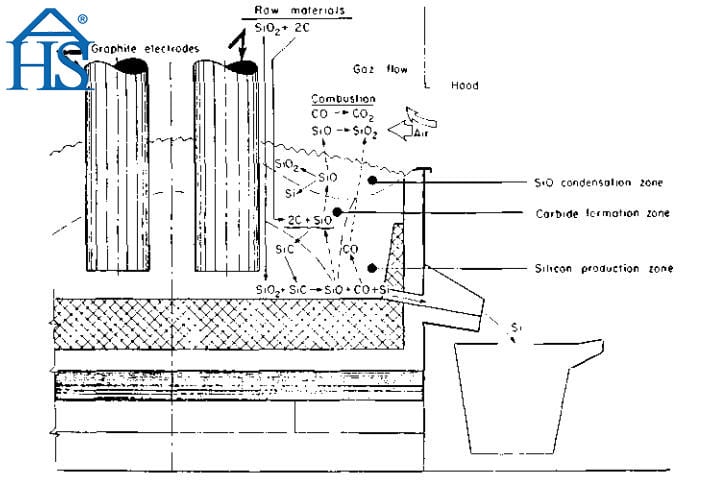
Production of Condensed Silica Fume
The use of wood chips in the burden can also influence to some extent the chemical composition of condensed silica fume, especially its carbon content, and also the loss on ignition (LOI) and the alkali content.
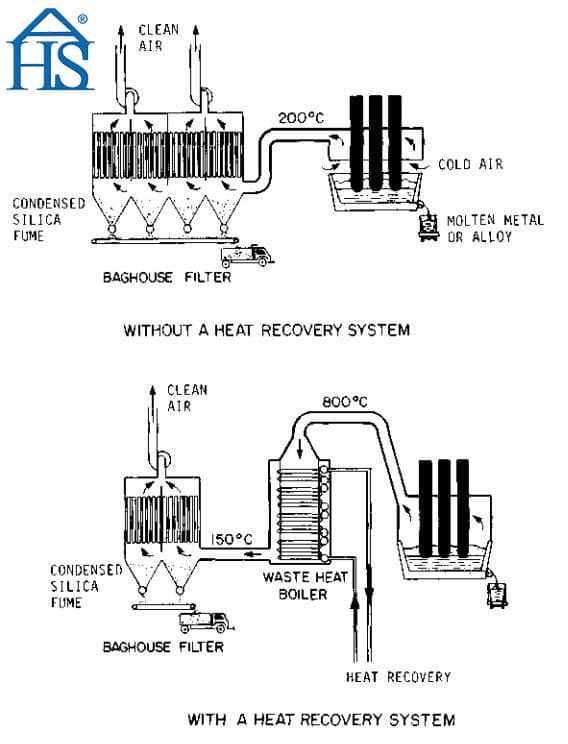
The design of the furnace, with or without a heat recovery system, not only influ-ences the color of condensed silica fume, but also its chemical composition, especially its carbon content. When the furnace is equipped with a heat recovery system gases leave the top of the furnace at about 800°C so that most of the carbon is com-pletely burned. In a conventional furnace, gases leave the furnace at about 200°C so that unburned carbon particles and some wood chips will be collected in the bag-house with condensed silica fume.
Desuden, the chemical composition of quartz and coal, the two major compo-nents of the burden of the submerged-electric arc furnace, influences to some extent the chemical composition of condensed silica fume. Although these materials are gen-erally of high purity, they have to be very carefully selected and controlled.
Generally as the amount of silicon increases in the final product the level of chemical impurities in condensed silica fume decreases.
Advantages of Condensed Silica Fume in Concrete
1. Meget stabile kemiske og fysiske egenskaber
Condensed Silica fume serves as a neutral filler with incredibly stable properties, både kemisk og fysisk. Det indeholder ikke krystallinsk vand, deltager ikke i hærdningsreaktionen, og påvirker ikke reaktionsprocessen på nogen måde.
2. Øget termisk ledningsevne
Ikke kun kan silica-røg øge den termiske ledningsevne, men det kan også forbedre flammehæmningen og ændre klæbehastigheden.
3. God adsorptionsydelse
Silica røg has a good adsorption performance, samt god nedsivning til forskellige typer harpiks. Desuden, det er let at blande uden et agglomerationsfænomen.
4. Reduceret nedbør og lagdeling
På grund af sin fornuftige fordeling og fine kornstørrelse, silica-røg effektivt kan eliminere lagdeling og reducere nedbør.
5. Forbedret styrke
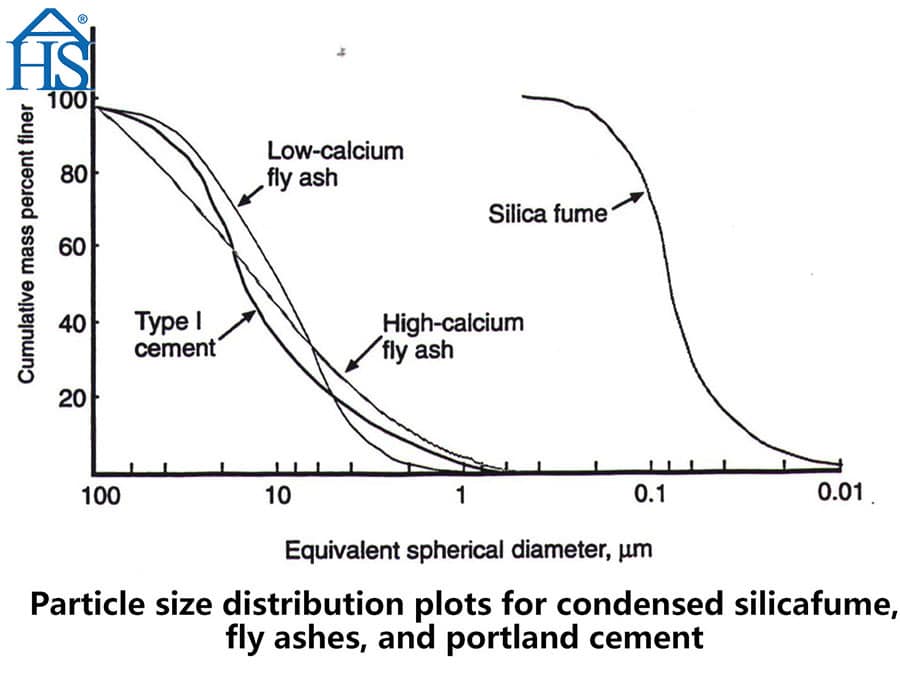
Den rimelige størrelsesfordeling af silicadampe sikrer god hårdhed, kraftig fortætning, og stor slidstyrke. Tilføjelse af silica-røg til beton kan forbedre slidstyrken, trykstyrke, og trækstyrke af hærdede produkter. Desuden, slidstyrken kan øges med 0.5-2.5 gange.
6. Forbedret isolering
Silica damp præsenterer rent siliciumpulver med en lav mængde urenheder. Som sådan, it possesses stable chemical and physical properties that ensure good arc resistance and insulation of the curing material.
7. Reducerede samlede omkostninger
Bulkdensiteten af silica-røg varierer mellem 0.2 og 0.8 eller 1.0 og 2.2. Når det bruges som polymerfyldningsmateriale, microsilica kan reducere de samlede omkostninger ved produktet ved at spare mængden af polymer og minimere mængden af belastning.
8. Forbedret korrosionsbestandighed
Silica-røg er sammensat af silica, eller SiO2, som er et inert materiale. Dette betyder, at silica-røg ikke reagerer med de fleste alkaloider eller syrer, og siliciumpulveret er jævnt fordelt over overfladen af genstande. Som sådan, silica dampe bidrager til forbedret kavitation og korrosionsbestandighed ved 3 til 16 gange.
9. Forkortet introduktionsperiode
Tilsætning af silica-røg til beton kan forkorte induktionsperioden og give tidlig styrke.
10. Forebyggelse af revner
Silicarøg kan reducere den maksimale temperatur, der opnås under hærdningsreaktionen af epoxyharpiks. Desuden, det reducerer krympningshastigheden og lineær ekspansionskoefficient i størknet beton, dermed reducere den indre belastning og forhindre revner.
11. Forbedret frostbestandighed
Det relative elasticitetsmodul for mikrosilica er kun 10 til 20 procent efter 300-500 Frysetøningscyklusser. På samme tid, det gennemsnitlige elasticitetsmodul for sædvanlig beton er 30 til 73 procent efter 25-50 cyklusser. Som sådan, tilsætning af mikrosilica til beton kan forbedre dens frostbestandighed betydeligt.
Condensed Silica Fume Supplier
Henan Superior Abrasives is one of the largest suppliers of silica fume in China, we supply silica fume to many famous companies around the world, such as sika, elkem, osv. We can supply densified and udensificeret silica damp with 85%-99% silica content.We can also produce according to your requirement. The machine is automatically packed and filtered by a screen, so that no debris is mixed in.We are the only silica fume factory in China that uses machine packaging.
Feel free to contact us for the latest 2023 quotation of silica fume.
E -mail:sales@superior-abrasives.com
Whatsapp:+86-18638638803


