指定者が SiO₂ 含有量が 90% 以上, 彼らには通常、正当な理由がある: the project demands more than ordinary supplementary cementitious materials can deliver. SF-90 sits at the upper end of the commercial silica fume range, and understanding exactly what that means — in terms of chemistry, パフォーマンス, and practical handling — helps you make a better decision at the mix design stage rather than discovering problems on site.
This article breaks down what SF-90 silica fume actually is, the applications where its high purity pays off, the trade-offs worth knowing before you specify it, and how to work with it effectively.
What Does “SF-90” Mean?
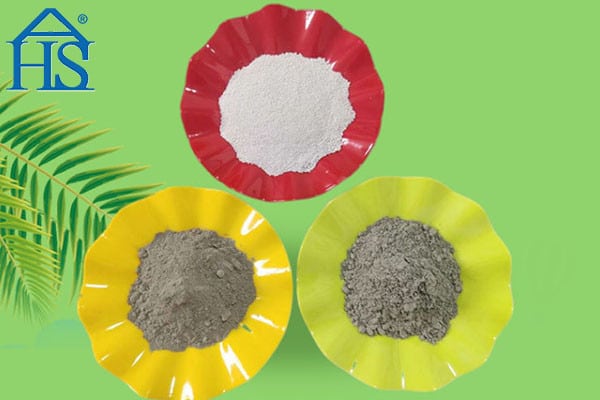
The designation SF-90 is a shorthand used across the industry to describe silica fume with a minimum silicon dioxide (SiO₂) content of approximately 90% 質量で. In practice, products sold under this label often test Greater than 90% SiO₂, depending on the raw silicon or ferrosilicon alloy being smelted and the collection efficiency of the bag-filter system.
Silica fume itself is an industrial by-product: ultrafine amorphous spheres of SiO₂ that condense in the flue gas stream when quartz is reduced in electric arc furnaces. The particles are extraordinarily small — typically 0.1 に 0.2 直径ミクロン, roughly 100 times finer than Portland cement — and that size is what drives most of its technical advantages. The high specific surface area (15,000–25,000 m²/kg for undensified product) means rapid, thorough reaction with calcium hydroxide in the cement paste.
の “90” threshold matters because reactivity is closely tied to amorphous SiO₂ content. A product at 85% SiO₂ will still perform well in most applications, but an SF-90 grade gives a larger pozzolanic reserve, which is useful when cement content is reduced for heat-of-hydration control, or when the highest possible strength and lowest possible permeability are the design targets.
For a full breakdown of the physical and chemical properties of silica fume, including how SiO₂ content interacts with specific surface area and activity index, that article goes into more depth.
Where SF-90 Grade Silica Fume Is Most Commonly Specified
Ultra-High-Performance Concrete (UHPC)
UHPC mixes routinely carry20–30% silica fume by weight of cement, sometimes more. At those dosages, purity matters: impurities that are tolerable at 5–8% addition in ordinary concrete can accumulate to concentrations that affect workability or long-term chemistry. SF-90 and above is the standard starting point for UHPC mix development.
Compressive strengths above 150 MPa are achievable with well-proportioned UHPC using SF-90 silica fume, steel fiber reinforcement, and a low water-to-binder ratio. The silica fume fills interparticle voids between cement grains (の “filler effect”) while simultaneously reacting with calcium hydroxide to form additional calcium silicate hydrate (の “pozzolanic effect”). Both mechanisms work in the same direction: denser microstructure, 低い気孔率, higher strength.
See silica fume for ultra-high-performance concrete for a detailed look at how mix proportioning affects UHPC outcomes.
高強度コンクリート (HSC) Above 60 MPa
ブリッジデッキ, high-rise columns, 海洋構造物, and industrial floors are typical high-strength applications. At 5–10% silica fume replacement of cement, SF-90 contributes meaningfully to early and long-term strength gain, and dramatically reduces chloride ion permeability — a critical factor in reinforced concrete exposed to deicing salts or seawater.
Silica fume in high-strength concrete covers the strength development curve and what to expect at different replacement levels.
Refractory and Castable Applications
High-purity silica fume is a standard component in dense refractory castables, where it serves as an ultrafine reactive binder. In refractory mixes, the chemistry is different from cementitious systems — the silica fume reacts at elevated temperatures rather than in an aqueous environment — but the fineness requirement is similar. SF-90 grade offers the purity margin that refractory formulators need when operating temperatures exceed 1,400°C or when chemical resistance to specific slags or fluxes is a design criterion.
Read more about the technical specifics in silica fume in refractory materials.
Protective Coatings and Grouts
SF-90 silica fume is also used in polymer-modified cement coatings, epoxy grouts, and cementitious repair mortars where low permeability and high bond strength are priorities. In these thin-section applications, the high surface area of the silica fume accelerates early strength gain and reduces bleed water, both of which matter when coating thickness is measured in millimeters.
高密度化 vs. 高密度化されていない: Which Form Is Right for Your Project?
SF-90 silica fume is available in two principal physical forms:
高密度化されていない (loose): Bulk density 200–350 kg/m³. The particles are in their natural agglomerate state — light, fluffy, and prone to dust generation. Preferred for applications where thorough dispersion in the mix is critical, because undensified material breaks up more readily under mixer action. It is also the form most often specified for refractory castables.
高密度化: Bulk density 500–700 kg/m³. Mechanically or pneumatically compacted into larger, friable agglomerates that handle and transport more like a conventional powder. Easier to batch by weight and significantly less dusty to handle. The agglomerates disperse under normal concrete mixer shear, provided sufficient mixing time and water reducer dosage.
For most ready-mix concrete and precast applications, densified SF-90 is the practical choice. For UHPC with very intensive mixing — such as in pan mixers or twin-shaft mixers — either form works, provided mixing protocol is validated.
Handling and Dosage Guidance
A few practical points that save time at the batching plant:
Superplasticizer is not optional. Silica fume increases the water demand of fresh concrete significantly. Without an adequate dosage of polycarboxylate-based high-range water reducer, you will offset the strength benefit with an increased water-to-binder ratio. Plan for superplasticizer demand to rise by 0.5–1.5% of binder weight for each 5% silica fume addition.
Typical dosage range: 5–10% by weight of cement for most structural concrete. UHPC mixes may reach 20–30%. Exceeding 10% in conventional concrete requires careful workability management and is usually only justified when very low permeability is the primary design target.
Curing is critical. Silica fume concrete is more sensitive to early drying than plain cement concrete because the dense microstructure reduces bleeding, and less bleed water at the surface means autogenous shrinkage can generate surface cracks if curing is delayed. Begin wet curing or apply curing compound immediately after finishing.
Dust control: Even with densified product, wear a properly fitted respirator rated for fine particles when handling. Silica fume in aggregate form is not considered a significant respirable crystalline silica hazard (the material is amorphous, not crystalline), but fine-particle inhalation of any kind should be avoided.
よくある質問
Q1: What is the difference between SF-85 and SF-90 silica fume?
The numbers refer to minimum SiO₂ content by mass. SF-85 contains at least 85% 二酸化ケイ素; SF-90 contains at least 90%. Higher SiO₂ means more reactive material per kilogram and is typically preferred in applications where maximum strength, minimum permeability, or chemical resistance drive the specification. For most ordinary structural concrete, SF-85 performs very well. SF-90 becomes the preferred grade in UHPC, dense refractory castables, and projects where mix designs have been validated at higher purity levels.
Q2: Can SF-90 silica fume be used to partially replace cement?
はい. Silica fume is a supplementary cementitious material and can replace Portland cement on a mass basis, typically at 1:1 に 1:1.5 replacement ratios depending on the performance requirements. Replacing cement reduces heat of hydration (useful in mass concrete) and cuts CO₂-associated embodied carbon. でも, silica fume does not replace all cement functions: it requires calcium hydroxide from cement hydration to react, so there is a practical lower limit on cement content in the mix.
Q3: Does SF-90 silica fume meet ASTM C1240 or EN 13263?
SF-90 products from reputable suppliers are formulated to comply with ASTM C1240 (which requires minimum 85% SiO₂) and EN 13263-1. The higher purity gives additional margin against these thresholds. Always request a current Certificate of Analysis and verify the activity index, 比表面積, and moisture content against the standard’s requirements for your project.
Q4: How should SF-90 silica fume be stored?
Store in a dry, covered environment away from moisture. Silica fume is hygroscopic and will absorb water if exposed, which affects bulk density and can cause agglomeration that resists dispersion in the mixer. Packaging in moisture-resistant bags (typically 1MT jumbo bags or 25 kg paper/PE bags) provides adequate protection for normal storage periods of up to 12 months from production date.
Q5: Is there a meaningful difference between SF-90 and SF-92 products in concrete performance?
In most concrete applications, the performance difference between90% and 92% SiO₂ is minor and within normal mix variability. The more important variables are particle size distribution, 比表面積, and how well the material disperses in the specific mixer and mix design being used. That said, UHPC researchers who have compared grades at high replacement levels (20%+) report measurable differences in reactivity and final porosity, so for those demanding applications the few extra percentage points of purity can matter.
About HSA Material
HSA Material is a China-based manufacturer and exporter of silica fume, マイクロシリカ, and related construction materials, supplying customers across more than 30 国. The company operates its own production facilities with capacity across multiple SiO₂ grades — from standard85% to high-purity 99% products — in both densified and undensified forms. HSA’s quality management system covers raw material sourcing, in-process testing, and pre-shipment certification, with products tested against ASTM C1240, の 13263, ギガバイト/トン 18736, and customer-specific specifications. Technical support, sample supply, and customized packaging are available for all order quantities.
Ready to Specify SF-90 Silica Fume for Your Next Project?
Whether you are developing a UHPC bridge deck specification, sourcing for a refractory castable, or scaling up production of high-strength precast elements, HSA Material can provide SF-90 silica fume with full documentation and reliable supply.
Contact HSA Material to request a sample, a Certificate of Analysis, or a delivered price quote for your project location. You can also visit the full silica fume product range to compare grades and forms, or reach out to the technical team via the service page for application-specific advice.