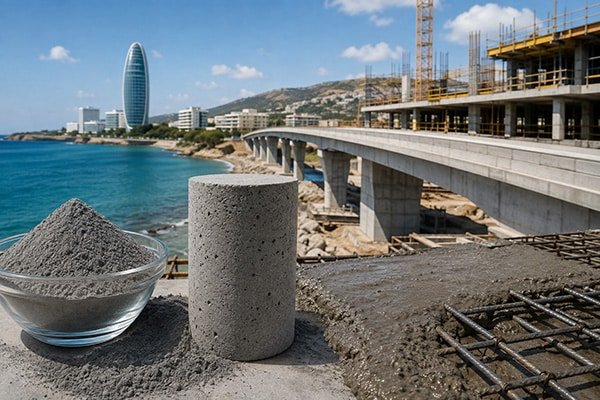
Cyprus is an island nation of the eastern Mediterranean and a member of the European Union since 2004. Its economy — built on tourism, shipping, professional services, and a sustained construction boom — is concentrated almost entirely along a narrow coastal strip, which means the country’s most valuable concrete sits within a few hundred meters of the sea. Salt-laden spray, chloride-bearing groundwater, long hot summers, and a coastline crowded with marinas, porturi, desalination plants, and high-rise towers combine to make coastal durability the defining engineering problem of Cypriot construction. The additive that has become central to solving it is Microsilica, cunoscut și sub numele de fum de silice.
This article explains why Cyprus’s marine climate and infrastructure pipeline create such specific demands for high-performance concrete, how microsilica meets those demands at the microstructural level, and how HSA Microsilica supports contractors, producători de preparate gata preparate, and engineering firms working across this fast-moving EU market.
Cyprus’s Coastal and Infrastructure Landscape
Cyprus is defined by its sea. Cu mai mult de 700 km of coastline and a hot semi-arid climate, the island experiences intense summer heat, high ultraviolet exposure, and persistent airborne chlorides that drift inland from the Mediterranean. Coastal structures are continuously bathed in a marine aerosol, while groundwater in many areas is mineral-rich and aggressive toward ordinary Portland-cement concrete. Pentru beton armat, the threat is concrete cancer by another name: chloride ions penetrate the cover, reach the reinforcing steel, break down its passive oxide film, and trigger corrosion that spalls the concrete and shortens structural life. This is not a hypothetical risk in Cyprus — it is the single most common cause of deterioration in its coastal and waterfront assets.
The project pipeline only sharpens the requirement. Coastal development continues to concentrate around marinas such as Limassol and Ayia Napa, port expansions at Limassol and Larnaca, and a wave of high-rise residential and commercial towers reshaping the Limassol skyline. On the water side, Cyprus now sources the large majority of its drinking water from desalination — its permanent units produce well over 235,000 m³ per day, covering roughly 70–80% of potable demand — and a €1.2 billion National Water Works Investment Plan aims to roughly double capacity toward 400,000 m³ per day by the end of the decade, adding new plants at Limassol port, Vasiliko, Episkopi, Mazotos, and elsewhere. Every one of these assets — intake and outfall structures, concrete tanks, pump stations, quay walls, and coastal towers — must resist chloride attack, high water pressure, and aggressive groundwater for decades with minimal intervention.
Why Coastal Concrete in Cyprus Needs Microsilica
Microsilica este un dioxid de siliciu amorf ultrafin (Sio₂) recuperate din gazele reziduale din topirea siliciului și ferosiliciului. Its particles are roughly 100 ori mai mici decât boabele de ciment, iar această finețe extremă îi conferă două mecanisme de armare în beton. First, a physical micro-umplutură efect: the tiny particles pack into the voids between cement grains, densifying the paste. Second, o reacție puzolanică: microsilica reacţionează cu hidroxidul de calciu eliberat în timpul hidratării cimentului pentru a forma silicat de calciu hidrat suplimentar (C-S-H), the very compound that gives concrete its strength and binds the matrix together.
The combined result is a hardened paste with a far finer, rețea de pori capilare mai puțin interconectate - și, prin urmare, permeabilitatea dramatic mai scăzută. This is why microsilica is a core ingredient in beton ultra-performant (UHPC), and why it is the most effective single addition available to a mix designer trying to keep chlorides out of the cover zone of a marine structure. Permeabilitatea mai scăzută înseamnă pătrunderea mai lentă a clorurilor, longer time to corrosion initiation, and a longer service life for the same concrete cover.
How Microsilica Solves Cyprus’s Core Concrete Challenges
1. Rezistență la cloruri împotriva stropilor de sare și a apei de mare
The primary threat to coastal reinforced concrete is chloride penetration. Prin rafinarea structurii porilor, microsilica sharply reduces the rate at which chloride ions migrate through the concrete cover to the steel. This is the single most valuable property for Cypriot marine and waterfront structures, and it is a well-documented mechanism in the guidance literature on marine durability. For a deeper look at how microsilica extends concrete life, see our explainer on the efectul microsiliciului asupra durabilității betonului.
2. Watertightness for Desalination and Water Infrastructure
Desalination plants, storage reservoirs, and coastal intake structures demand concrete that holds back both seawater and high-pressure potable water without leaking or deteriorating. Pasta densificată pe care o produce microsilica scade dramatic permeabilitatea, producing watertight structures that resist seepage. This is the same property leveraged in fum de silice pentru impermeabilizare aplicatii, and it matters acutely in a country that now depends on desalination for most of its drinking water.
3. High Compressive Strength for High-Rise and Long-Span Structures
Limassol’s waterfront towers and the island’s bridges and marine decks need concrete that can carry heavy structural loads while standing up to a marine environment. Microsilica împinge în mod fiabil rezistența la compresiune mult dincolo de atingerea amestecurilor obișnuite, motiv pentru care se ancorează fum de silice în beton de înaltă rezistență. Higher strength also allows slimmer columns and lighter structures on coastal sites where land is scarce and wind and seismic loads govern the design.
4. Sulfate Resistance Against Aggressive Groundwater
Much of Cyprus’s groundwater and coastal subsoil is sulfate-bearing, and sulfate attack gradually degrades the cement paste of foundations, grămezi, and buried structures. Cel dens, low-permeability matrix produced by microsilica resists sulfate ingress and chemical deterioration far better than ordinary Portland-cement paste, protecting foundations, retaining walls, and marine substructures from aggressive ground conditions.
5. Extended Service Life and Lower Maintenance
The economics of a desalination plant, a quay wall, or a coastal tower are dominated by the cost of keeping it standing, not just the cost of pouring it. Because microsilica slows chloride ingress, carbonation, and sulfate attack, it extends the time to first major repair and cuts whole-life maintenance. For bridge decks and marine decks subjected to chlorides, this is the logic behind fum de dioxid de siliciu pentru suprapuneri de poduri, where a durable, low-permeability overlay is the cheapest way to protect the deck below.
Where Cyprus Projects Are Applying Microsilica
| Aplicație | Cyprus Context | Beneficiul cheie Microsilica |
|---|---|---|
| Desalination intake/outfall and process structures | Permanent and new mobile units at Limassol port, Vasiliko, Episkopi, Mazotos | Etanșeitate la apă, rezistenta la cloruri si sulfati |
| Marina quay walls, pontoons, și digurile | Limassol Marina, Ayia Napa Marina, Larnaca redevelopment | Seawater durability, permeabilitate scăzută, viata lunga |
| Coastal high-rise towers | Limassol waterfront residential and commercial towers | Rezistență ridicată, acoperire redusă, rezistență la clorură |
| Port and marine structures | Limassol and Larnaca port expansions | Abrasion and chloride resistance, durabilitate |
| Bridge decks and coastal road infrastructure | Motorway network and marine crossings | Low-permeability overlays, sulfate resistance |
| Precast pipes, canalele, and marine elements | Precast yards supplying water and coastal projects | Forță timpurie ridicată, faster mold turnover |
Best Practices for Specifying Microsilica in Cypriot Projects
- Doza împotriva expunerii, nu doar puterea. Într-un mediu marin, specificați mai întâi doza necesară pentru a atinge clasa de permeabilitate la clorură necesară (în mod obișnuit, 5-10% din greutatea materialului cimentant), apoi confirmați rezistența la compresiune.
- Potriviți nota cu aplicația. Microsilica nedensificată se dispersează cu ușurință în producția de amestecuri umede și gata de amestecare, în timp ce gradele densificate se potrivesc manipulării în vrac, praf mai mic, and larger batching plants — choose the form that fits the site and mixing equipment.
- Asortați cu un reductor de apă de nivel înalt. Suprafața mare a Microsilicei crește cererea de apă; un superplastifiant compatibil menține amestecul funcțional, păstrând în același timp raportul scăzut apă-ciment de care depinde rezistența la clorură.
- Verify conformity against European standards. As an EU member, Cyprus adopts European norms — concrete under CYS EN 206 and silica fume under CYS EN 13263. Request certificates of analysis covering SiO₂ content, fineţe, and pozzolanic activity index, and align with the national technical committees overseen by the Cyprus Organisation for Standardisation (CYS).
- Protect the cover and cure properly. Marine structures live or die by their concrete cover to the reinforcement; specify adequate cover, and follow marine-durability curing guidance such as that published by the American Concrete Institute to ensure the densified paste actually reaches its design impermeability.
Întrebări frecvente
Why is microsilica preferred over ordinary admixtures for marine concrete in Cyprus?
Microsilica abordează modul de defectare definitoriu al betonului de coastă - coroziunea armăturii indusă de clorură - prin densificarea fizică a pastei și reacția puzolanică pentru a închide porii capilari.. Puține alte adaosuri reduc permeabilitatea clorurilor, creste puterea, și îmbunătățirea etanșeității la apă într-un singur material, așa cum o face microsilica.
Este microsilice potrivit pentru betonul din instalațiile de desalinizare care intră în contact cu apa de mare și saramură?
Da. Permeabilitatea scăzută și rezistența chimică a betonului microsilice îl fac bine potrivit pentru absorbție, deversare, și structurile de proces expuse la apă de mare și saramură concentrată, where watertightness and resistance to chloride and sulfate attack are essential over a long service life.
Cum protejează microsilica oțelul de armare de atacul clorurii?
Microsilica rafinează structura porilor capilare a pastei întărite, încetinind dramatic viteza cu care ionii de clorură migrează prin învelișul de beton. Acest lucru întârzie momentul în care clorurile ajung în oțel și îi descompun filmul protector de oxid, extending the time to corrosion initiation and the overall service life.
Adăugarea de microsilice crește semnificativ costul unui proiect de coastă??
Material cost per cubic meter rises modestly, dar economiile dintr-o durată mai lungă, Structura cu întreținere redusă domină de obicei pe durata de viață a activului - în special pentru infrastructura marină și acvatică, unde accesul la reparații este dificil, perturbatoare, si scumpe, and where premature deterioration can threaten water supply continuity.
Can HSA Microsilica supply microsilica into Cyprus reliably?
Da. Cyprus is well connected through the ports of Limassol and Larnaca and the wider eastern Mediterranean shipping lanes, and HSA Microsilica ships densified and undensified grades in bulk bags and containers into the region with full documentation, supporting desalination, marin, and high-rise construction programs.
About HSA Microsilica
HSA Microsilica is a specialized manufacturer and global supplier of silica fume, densified and undensified microsilica, and related pozzolanic materials for the concrete, marin, refractar, and construction chemicals industries. With rigorous quality control and export experience across Europe, Orientul Mijlociu, the Americas, and Asia-Pacific, HSA Microsilica supports engineers and contractors working under CYS EN 206, ASTM C1240, and other international standards. Our team understands the technical demands of coastal and marine construction — from chloride resistance and waterproofing to high-strength and precast production — and provides full documentation, including certificates of analysis and pozzolanic activity data, with every shipment.
Pentru antreprenori, producători de preparate gata preparate, and engineering firms sourcing microsilica for desalination, marina, port, or high-rise projects in Cyprus and the wider eastern Mediterranean, HSA Microsilica oferă atât grade densificate, cât și nedensificate, potrivite pentru amestecare gata, marin, și aplicații prefabricate. Contactați echipa noastră de vânzări tehnice pentru a discuta despre suportul pentru proiectarea mixului, prețuri în vrac, și programarea livrărilor pentru următorul dvs. proiect.