

Green building certification has moved from a niche aspiration to a mainstream procurement requirement. LEED — Leadership in Energy and Environmental Design — remains the world’s most widely adopted framework, with more than 100,000 certified projects across 180 Länder. For owners, developers, and project teams pursuing LEED certification, every material decision carries point implications, and the cumulative effect of those decisions determines whether a project achieves Certified, Silver, Gold, or Platinum status.
Beton, as the most consumed construction material on Earth, sits at the center of any serious LEED materials strategy. And within the concrete mix, microsilica — also called silica fume or condensed silica fume — is one of the few individual admixtures capable of contributing meaningfully across multiple LEED credit categories simultaneously. Understanding precisely how it does so is essential knowledge for sustainability-conscious engineers, specifiers, and project managers.
What is LEED and how does it score materials?
LEED v4 and v4.1, the current operative versions, assess buildings across eight credit categories: Location and Transportation, Sustainable Sites, Water Efficiency, Energy and Atmosphere, Materials and Resources, Indoor Environmental Quality, Innovation, and Regional Priority. For most structural and envelope materials, the relevant categories are Materials and Resources (MR) und, increasingly, the whole-building life-cycle assessment credits that span Energy and Materials.
Within Materials and Resources, LEED v4.1 places particular emphasis on four pathways: Environmental Product Declarations (EPDs), sourcing of raw materials, material ingredient reporting, and — most relevant to microsilica — the recycled content and low-embodied-carbon credentials of structural materials. Projects earn points by documenting that a threshold proportion of their materials (by cost) meet defined sustainability criteria.
Microsilica as a recovered industrial byproduct
The most direct LEED contribution of microsilica comes through its classification as a recovered industrial byproduct. Microsilica is generated as a co-product of silicon metal and ferrosilicon alloy production in electric arc furnaces. Without collection and beneficial use, it would be classified as an industrial waste requiring disposal. Its diversion into concrete applications is a textbook example of industrial symbiosis — one industry’s waste stream becoming another’s high-value input.
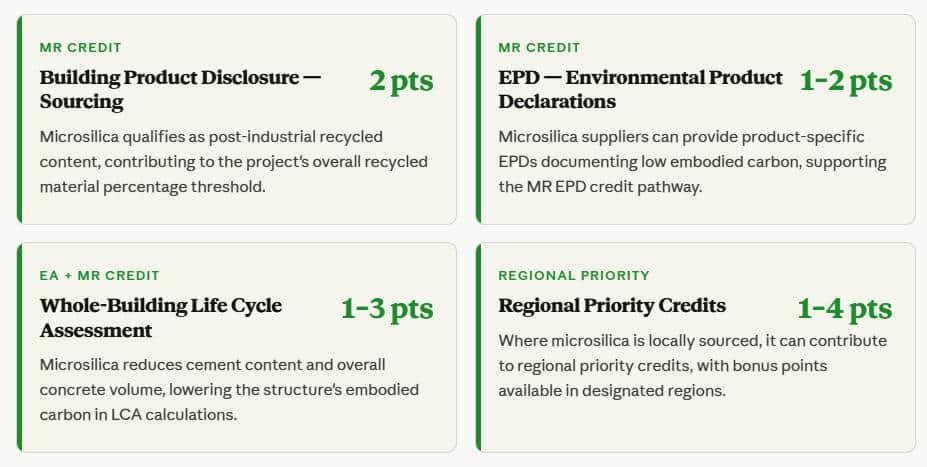
Under LEED v4.1’s MR Credit: Building Product Disclosure and Optimization – Sourcing of Raw Materials, materials that are derived from recycled or reclaimed sources contribute toward the project’s recycled content percentage. Microsilica qualifies as a post-industrial recycled material, and its use in concrete mix designs contributes to the project’s overall recycled content calculation. When microsilica is used at 10–25% by mass of cementitious materials — a typical range for Hochleistungsbeton — its contribution to the concrete’s recycled content by weight is straightforward to document and verify.
Reducing cement content — and embodied carbon
Perhaps the most significant, if less immediately obvious, LEED contribution of microsilica lies in what it allows engineers to remove from the mix rather than what it adds. Portland cement clinker carries one of the highest embodied carbon intensities of any construction material — approximately 0.83 kg CO₂ per kilogram of clinker produced, primarily from the calcination of limestone and the fuel combustion required to reach kiln temperatures of 1,450°C. Globally, cement production is responsible for approximately 7–8% of all anthropogenic CO₂ emissions.
Mikrosilika is a highly efficient cement replacement. Because it reacts pozzolanically with calcium hydroxide released during cement hydration — converting it into additional calcium silicate hydrate (C-S-H) gel — it can replace Portland cement on a less-than-equal mass basis and still achieve equal or superior strength outcomes. In practice, A 10% replacement of cement by microsilica in a high-performance concrete mix reduces the cement content by 10% while maintaining or improving compressive strength, Haltbarkeit, und Undurchlässigkeit. This translates directly into a proportional reduction in the concrete’s embodied carbon footprint.
Every kilogram of Portland cement replaced by microsilica removes approximately 0.83 kg of CO₂ from the concrete’s embodied carbon inventory — at no cost to structural performance, and often with a measurable improvement in durability.
In the context of LEED’s whole-building life-cycle assessment (LCA) credit, this embodied carbon reduction is quantifiable and documentable. Projects that use microsilica-enhanced concrete mixes can demonstrate lower global warming potential (GWP) for their structural system compared to a conventional concrete baseline, directly supporting the LCA credit under LEED v4.1 Materials and Resources.
Haltbarkeit, service life, and lifecycle carbon
LEED’s environmental accounting does not stop at the construction phase. Zunehmend, certification frameworks — including LEED v4.1 and the emerging ISO 21930 framework — consider whole-life carbon, which includes operational energy, Wartung, and end-of-life impacts. Hier, microsilica’s extraordinary durability contribution becomes a sustainability multiplier.
The dense, low-permeability microstructure produced by pozzolanic reaction with microsilica dramatically reduces chloride ion penetration, carbonation depth, and water absorption — the three primary pathways through which concrete deteriorates and requires repair or replacement. A microsilica-enhanced structural concrete element that achieves a service life of 100 years instead of 60 years embodies, per year of service, grob 40% less material production impact. When this extended service life is incorporated into a whole-building LCA, the environmental benefit of microsilica compounds significantly beyond the initial embodied carbon reduction.
Indoor environmental quality: a lesser-known benefit
Microsilica’s contribution to LEED’s Indoor Environmental Quality (IEQ) category is indirect but real. By significantly reducing concrete permeability, microsilica-enhanced concrete floors and walls exhibit lower moisture vapor emission rates (MVER) — a critical parameter for flooring adhesive compatibility and indoor air quality. High MVER from conventional concrete slabs is a leading cause of flooring system failures, adhesive off-gassing, and mold growth risk. Specifying microsilica in slab-on-grade and elevated floor designs contributes to a lower-permeability substrate that reduces long-term IEQ risks, supporting the project team’s ability to demonstrate a healthy interior environment.
The EPD pathway: documenting microsilica’s environmental profile
Environmental Product Declarations (EPDs) are the documentary currency of LEED materials credits. An EPD is a standardized, third-party-verified report that quantifies a product’s environmental impacts across its lifecycle — from raw material extraction through manufacturing, verwenden, and end of life — expressed in metrics including global warming potential, ozone depletion, acidification, and eutrophication.
Under LEED v4.1’s MR Credit: Building Product Disclosure and Optimization – Environmental Product Declarations, projects earn points when a defined proportion of products (by cost) have EPDs available. Microsilica producers who have obtained product-specific EPDs — rather than industry-average EPDs — provide project teams with the most accurate and defensible documentation. Product-specific EPDs for microsilica consistently demonstrate a very low embodied carbon profile relative to the structural performance contribution the material makes, making it one of the most favorable materials to include in a LEED project’s MR credit portfolio.
| LEED v4.1 Credit | Kategorie | Microsilica Contribution | Potential Points |
|---|---|---|---|
| EPD — Product Disclosure | MR | Product-specific EPD available | Bis zu 2 pts |
| Sourcing — Recycled Content | MR | Post-industrial recycled byproduct | Bis zu 2 pts |
| Whole-Building LCA | MR | Reduces structural GWP vs baseline | Bis zu 3 pts |
| Regional Priority | RP | Locally sourced microsilica | Bis zu 4 pts |
| Innovation Credit | IN | Exemplary performance in recycled content | 1 pt |
| Indoor Env. Quality (indirect) | IEQ | Low MVER, reduced mold/off-gas risk | Supporting |
Practical guidance for LEED project teams
For project teams actively pursuing LEED certification, integrating microsilica into the concrete specification is one of the highest-value material decisions available. The pathway is straightforward: specify microsilica at 10–15% by cementitious mass for standard HPC applications, or 20–25% for UHPC, request full EPD and recycled content documentation from your supplier, and ensure your structural engineer of record updates the mix design to reflect the cement replacement and verify compliance with ACI 318 or equivalent structural code requirements.
The documentation burden is modest compared to the credit returns. A single material substitution — replacing a portion of Portland cement with a verified, EPD-backed microsilica powder — can unlock contributions across three or more LEED credit categories, support a measurable reduction in the project’s embodied carbon LCA, and deliver a more durable structure that performs better across its entire service life. In a certification framework where every point counts and where the gap between Silver and Gold is often bridged by careful material specification, microsilica deserves a prominent place in every LEED project’s concrete strategy.
LEED-ready microsilica powder, documented and export-certified
Henan Superior Abrasives supplies high-purity densified and undensified silica fume powder to green building projects and concrete producers in 30+ Länder. Our products are fully compliant with ASTM C1240 and EN 13263, and we provide complete technical documentation packages — including EPD support, certificate of conformance, recycled content declarations, and country of origin certification — to support your LEED credit submissions.


