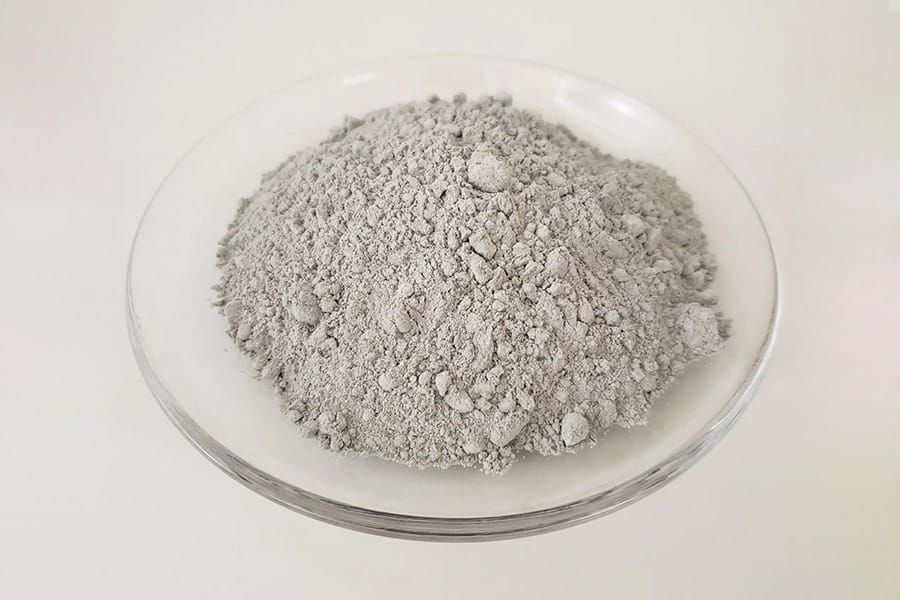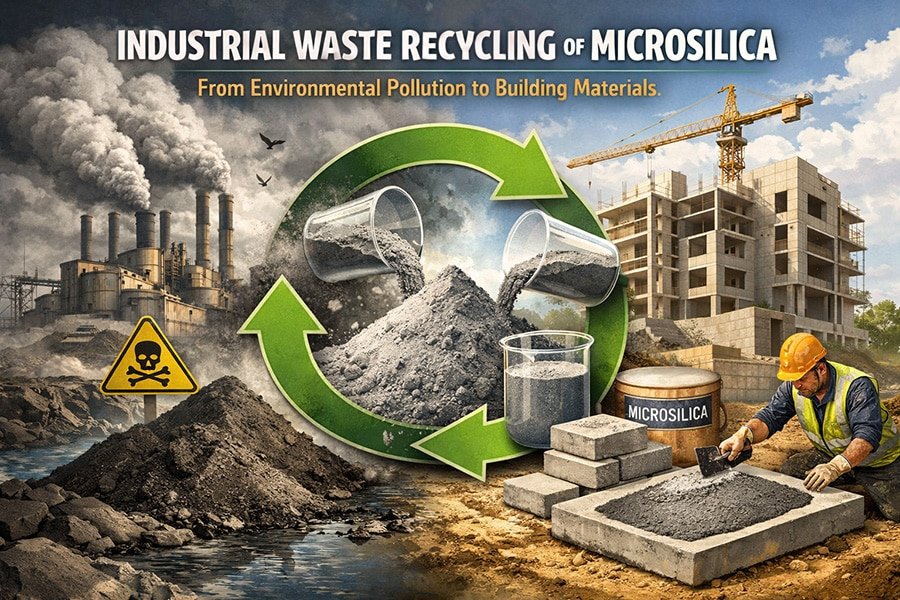
For much of the twentieth century, the thick grey plumes rising from silicon and ferrosilicon smelting furnaces represented one of the metallurgical industry’s most persistent environmental headaches. The ultrafine silicon dioxide particles that condensed in the exhaust gas — too light to settle, too fine to filter economically with early technology — drifted into surrounding communities, contaminating soil, fouling water sources, and causing respiratory illness among workers and nearby residents. The material had no recognized commercial value, and its disposal consumed considerable cost and regulatory attention. Today, that same material — now collected, processed, and sold as microsilica or silica fume — is a globally traded commodity worth hundreds of millions of dollars annually, and it is quietly transforming concrete performance across the construction industry. The story of microsilica’s rehabilitation from pollutant to performance material is one of the more instructive examples of industrial waste valorization in modern materials science.
The pollution problem: where microsilica comes from
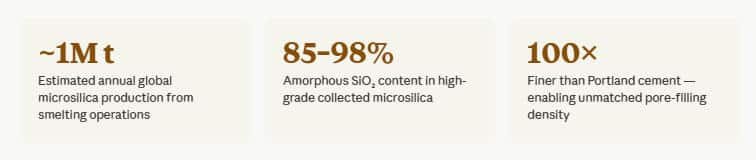
Microsilica is generated during the high-temperature reduction of quartz (SiO₂) with coal or coke in electric arc furnaces used to produce silicon metal, ferrosilicon alloys, and silicon carbide. At furnace temperatures exceeding 2,000°C, silicon vapor escapes from the melt and, upon contact with oxygen in the cooler upper zones of the furnace, oxidizes back to silicon dioxide. This re-oxidized SiO₂ condenses into extraordinarily fine spherical particles — typically 0.1 to 0.3 micrometers in diameter — that remain suspended in the furnace exhaust gas as a dense aerosol.
Before modern filtration systems were mandated by environmental regulation, this aerosol was simply released to the atmosphere. Studies from the 1960s and 1970s documented significant silicosis risk among smelter workers exposed to the uncontrolled emissions, and surrounding agricultural land in major silicon-producing regions of Norway, Iceland, China, and Brazil showed measurable silicon dioxide deposition rates that altered soil chemistry. The particles were also incompatible with early fabric filter technology — their extreme fineness caused rapid filter blinding and high pressure drops — making economical collection a genuine engineering challenge.
The collection breakthrough: turning a liability into an asset
The transition from uncontrolled emission to recoverable commodity was driven primarily by tightening air quality regulation in Scandinavia and North America during the 1970s. As smelters were compelled to install baghouse filters and electrostatic precipitators to comply with particulate emission limits, a curious thing happened: the collected dust turned out to have extraordinary physical and chemical properties. Norwegian researchers, notably at the SINTEF institute in Trondheim, were among the first to systematically characterize the collected material and recognize its potential as a pozzolanic cement additive. Their work in the late 1970s and early 1980s laid the scientific foundation for what would become the microsilica industry.
Modern collection systems use high-efficiency bag filters installed downstream of the electric arc furnace. The exhaust gas stream passes through filter bags made of woven or felted synthetic fibers, which capture particles as fine as 0.1 μm with collection efficiencies above 99.9%. The collected dust is then transferred pneumatically to storage silos, from which it can be bagged in densified powder form, blended into aqueous slurry, or compacted into pellets for bulk transport. The transformation from hazardous air pollutant to marketable industrial mineral is complete within the same facility that produces the pollution.
Arc furnace
Silicon vapor oxidizes at 2,000°C+ forming ultrafine SiO₂ aerosol
Bag filtration
High-efficiency filters capture >99.9% of particles from exhaust
Processing
Densification, quality grading, and packaging into powder
Application
Used in concrete, refractory, rubber, and specialty building materials
Why microsilica is so effective in concrete
The same physical properties that made raw microsilica such a difficult pollutant — its extreme fineness and chemical reactivity — are precisely what make processed microsilica so valuable as a concrete additive. In a cement paste, microsilica particles fill the nanoscale voids between cement grains through a physical packing mechanism, dramatically reducing the porosity of the hardened matrix. Simultaneously, the amorphous SiO₂ undergoes a pozzolanic reaction with calcium hydroxide released during cement hydration, forming additional calcium silicate hydrate (C-S-H) gel — the primary strength-giving phase in concrete.
The combined effect is a concrete that is denser, stronger, and significantly more durable than its plain cement equivalent. Compressive strength gains of 30–80% are routinely reported at equivalent water-to-binder ratios. Chloride ion penetration — the primary cause of reinforcement corrosion in marine and de-iced bridge environments — is reduced by one to two orders of magnitude. Resistance to sulfate attack, alkali-silica reaction, and freeze-thaw cycling is similarly enhanced. These performance benefits are not marginal: they are the difference between a structure requiring major maintenance at 20 years and one that can serve 75–100 years with minimal intervention.
The material that once settled on surrounding farmland and filled workers’ lungs is now extending the service life of bridges, tunnels, and marine infrastructure by decades. Few industrial waste streams have undergone a more complete transformation of public perception.
Environmental accounting: the full lifecycle picture
The environmental case for microsilica use in construction goes beyond simply diverting a waste stream. When considered on a full lifecycle basis, microsilica-enhanced concrete delivers a compelling sustainability argument. First, as a recovered byproduct, microsilica production requires no primary mining, no ore processing, and no calcination — the energy-intensive step that accounts for the bulk of Portland cement’s carbon footprint. The energy cost of collecting, processing, and densifying microsilica is a fraction of the cost of producing an equivalent mass of cement clinker.
Second, because microsilica enables higher-strength concrete, less material is needed to achieve a given structural performance target. A column or slab designed in microsilica-enhanced high-performance concrete may use 30–50% less concrete volume than an equivalent element in ordinary structural concrete — with direct reductions in cement consumption, aggregate extraction, and transport emissions. This geometric efficiency is particularly powerful in combination with advanced structural forms like ultra-thin shell structures, long-span bridges, and slender façade panels.
Third, the durability premium translates directly into reduced maintenance activity over the structure’s life — fewer repair cycles means fewer raw material inputs, fewer vehicle movements to site, and a smaller cumulative environmental footprint per year of service. Life-cycle assessment studies consistently show that high-performance concrete incorporating microsilica has lower lifetime environmental impact than ordinary concrete, despite the higher upfront material cost per cubic meter.
Circular economy classification: Under the EU Taxonomy for Sustainable Finance and the Ellen MacArthur Foundation’s circular economy framework, microsilica qualifies as a secondary raw material — a recovered industrial residue that substitutes for primary resources. Its use in concrete is recognized as a circular economy activity in multiple national green building rating systems, including LEED (recycled content credit), BREEAM, and the Chinese Green Building Evaluation Standard (GB/T 50378).
Beyond concrete: other applications in construction materials
While concrete is the dominant market for microsilica, its properties support a range of other building material applications. In refractory ceramics and castables used to line industrial furnaces and kilns, microsilica acts as a reactive binder phase that significantly improves hot-strength and thermal shock resistance. In grouts and repair mortars, it reduces bleed water and increases early strength gain, improving bond to existing substrates. In fiber-cement composites — including façade cladding and roofing products — microsilica enhances density and reduces water absorption, improving weathering resistance.
Emerging research is also exploring microsilica’s role in geopolymer binders, where it serves as the silica source for the aluminosilicate network that replaces Portland cement entirely. In these systems, microsilica combines with fly ash or GGBS and an alkaline activator to produce a binder with compressive strengths comparable to OPC but with significantly lower embodied carbon — as low as 40–80% reduction depending on the activator source. This positions microsilica as a key material not just for incremental improvement of conventional concrete, but for the next generation of low-carbon binder systems.
The global microsilica market and supply chain
Global microsilica production is geographically concentrated in regions with significant silicon and ferrosilicon smelting capacity: China (by far the largest producer), Norway, Iceland, Brazil, South Africa, and the United States. China accounts for an estimated 60–70% of global production, and Chinese producers have progressively improved quality consistency over the past two decades to meet international construction standards including ASTM C1240 and EN 13263. The market is increasingly segmented by SiO₂ content — with 85%, 92%, 94%, 96%, and 98%+ grades commanding progressively higher premiums — and by physical form, with densified powder, and compacted pellet each serving different logistics and application needs.
For construction specifiers and procurement professionals, understanding the supply chain behind microsilica is important context: the material’s quality, consistency, and traceability depend heavily on the upstream smelter’s process control, the efficiency of the collection system, and the rigor of the downstream quality management system. Not all microsilica grades are suitable for all applications, and specifying by SiO₂ content alone, without attention to LOI, chloride content, surface area, and batch consistency, can lead to variable concrete performance in the field.
Henan Superior Abrasives
Henan Superior Abrasives (HSA) is a leading Chinese manufacturer and global exporter of high-purity microsilica (silica fume) and industrial mineral products. With production facilities in Henan Province — one of China’s primary silicon alloy manufacturing regions — HSA sources microsilica directly from verified electric arc furnace operations and applies rigorous quality control at every stage of collection, processing, and packaging. HSA products comply with ASTM C1240, EN 13263, and GB/T 18736, and are supplied to construction material producers, ready-mix operations, oilfield service companies, and refractory manufacturers across Asia, Europe, the Middle East, and the Americas.
Get verified microsilica from a manufacturer you can trust
Henan Superior Abrasives supplies ASTM C1240 and EN 13263 compliant microsilica in bulk, with full batch documentation, technical datasheets, and application support — direct from our Henan production base to your project site, anywhere in the world.
Frequently asked questions
Is microsilica considered a hazardous material during handling and use?
Uncontrolled microsilica emissions from smelting operations are classified as a respiratory hazard due to the fine particle size and elevated SiO₂ content, which can cause silicosis with prolonged unprotected exposure. However, commercially processed and densified microsilica — the form used in construction — is classified as a nuisance dust rather than a hazardous substance under most occupational health regulations, provided standard dust control measures are observed during batching and mixing. Workers should use appropriate respiratory protection (FFP2 or equivalent) when handling undensified microsilica powder in enclosed spaces. Slurry forms carry minimal dust exposure risk. HSA supplies full Safety Data Sheets (SDS) compliant with GHS/REACH requirements with every product delivery.
How is microsilica different from other industrial waste pozzolans like fly ash or GGBS?
Fly ash (from coal combustion) and GGBS (ground granulated blast-furnace slag from steelmaking) are also industrial byproducts used as supplementary cementitious materials, but they differ fundamentally from microsilica in particle size, reactivity, and mechanism. Microsilica particles are 50–100 times finer than fly ash and GGBS, enabling nanoscale pore filling that the other materials cannot replicate. Microsilica is also more rapidly reactive — its pozzolanic reaction is essentially complete within 28 days, while fly ash continues to react slowly for months to years. In terms of SiO₂ content, high-grade microsilica (92–98%) significantly outperforms Class F fly ash (typically 50–70% SiO₂) and GGBS (which is primarily calcium aluminosilicate). Each material has appropriate applications, but microsilica is the material of choice when maximum strength, minimum permeability, and rapid strength development are required simultaneously.
What is the difference between densified and undensified microsilica?
Raw collected microsilica (undensified) has a bulk density of only 130–430 kg/m³, making it extremely difficult to handle, transport, and batch accurately — it behaves almost like smoke and is prone to dusting and segregation. Densified microsilica is mechanically compacted (typically by air agitation in a silo) to achieve bulk densities of 480–720 kg/m³, making it far more manageable for bulk transport and standard batching systems. Critically, densification does not alter the particle size or chemical reactivity of the individual microsilica particles — it simply packs them into larger, friable agglomerates that break apart during mixing. Slurry microsilica (50% solids by mass) offers the best dispersion homogeneity of all three forms and is preferred for the most demanding UHPC and 3DCP applications where particle agglomeration must be minimized. HSA supplies all three forms across its microsilica product range.
Which microsilica grade is right for my concrete application?
Grade selection depends primarily on the target performance level and applicable standard. For ordinary high-performance concrete (HPC) in bridge decks, marine structures, and industrial floors, 85% SiO₂ grade meets ASTM C1240 and EN 13263 minimum requirements and is the most economical choice. For ultra-high performance concrete (UHPC), 3D printed concrete, or oilwell cementing, 92–96% SiO₂ grades are recommended to maximize pozzolanic reactivity and minimize inert impurities that consume mix water without contributing to strength. For refractory castables and specialty ceramics, very high purity grades (94–98%) with controlled impurity levels (Al₂O₃, Fe₂O₃, CaO) are typically specified. Henan Superior Abrasives’ technical team can advise on grade selection, optimal dosage, and compatibility with your specific cement and admixture system — contact us with your application requirements for a tailored recommendation.
Does using microsilica contribute to green building certifications?
Yes, in several meaningful ways. Under LEED v4, microsilica contributes to the Building Product Disclosure and Optimization — Sourcing of Raw Materials credit as a recycled industrial byproduct, and may contribute to the Recycled Content credit depending on the project’s accounting methodology. Under BREEAM, the use of secondary or recycled materials in structural concrete supports the Materials credits. The Chinese Green Building Evaluation Standard (GB/T 50378) similarly recognizes secondary cementitious materials in its material efficiency indicators. Beyond certification credits, the extended service life enabled by microsilica-enhanced concrete is increasingly recognized in whole-building lifecycle assessment (LCA) tools — including the EN 15978 framework used across Europe — as a primary lever for reducing a building’s operational carbon footprint over its service life.