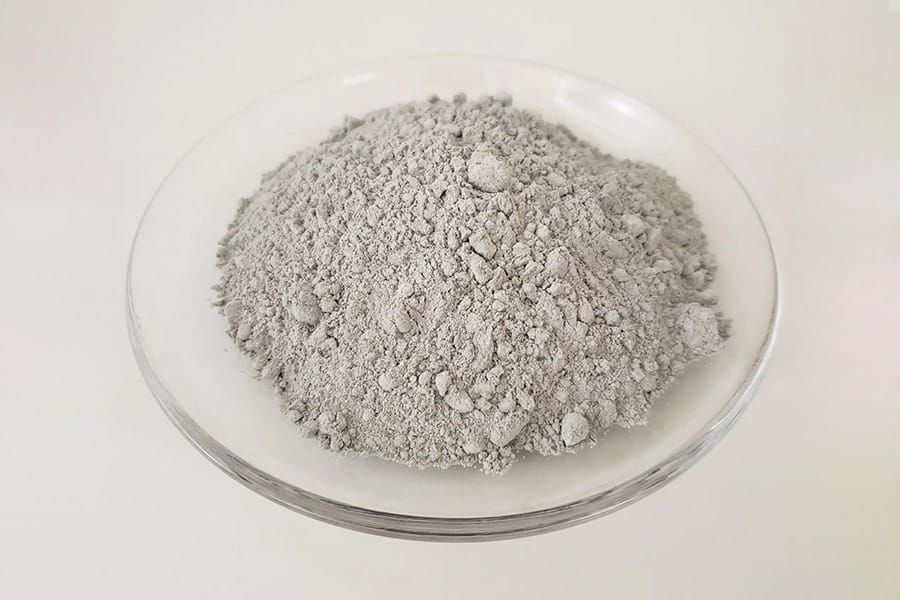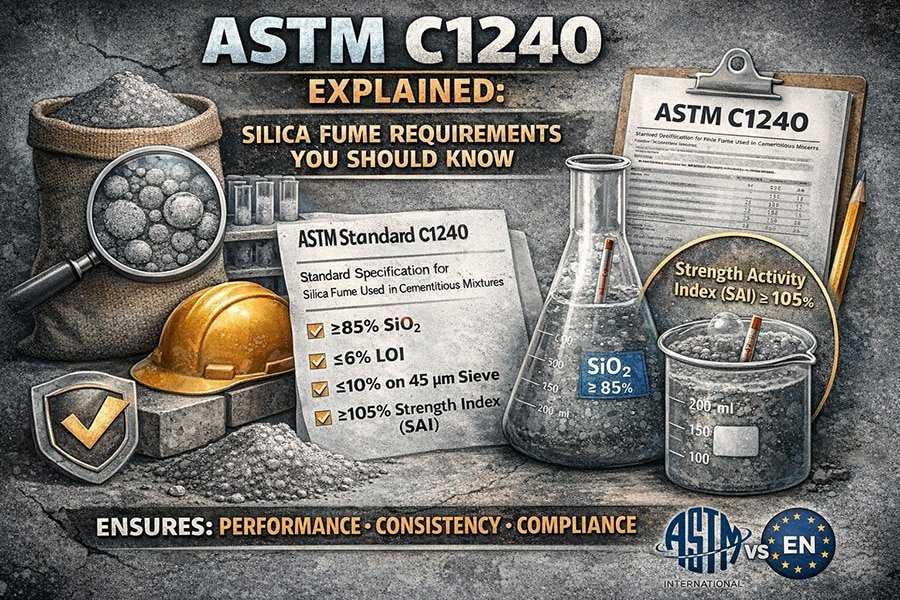
ASTM C1240 is the most widely recognized international standard governing the quality of silica fume used in concrete. For engineers, contractors, and importers, understanding this standard is essential to ensure performance, consistency, and compliance in high-performance concrete applications.
What Is ASTM C1240?
ASTM C1240 is the Standard Specification for Silica Fume Used in Cementitious Mixtures.
It defines:
- Chemical composition limits
- Physical performance requirements
- Quality consistency for silica fume used in concrete and mortar
The standard applies to:
- Undensified silica fume
- Densified silica fume
- Slurried silica fume
👉 It does not dictate how to use silica fume in mix design, but ensures the material itself meets minimum quality benchmarks.
Why ASTM C1240 Matters
Silica fume is a highly reactive pozzolanic material. Without proper quality control, poor-grade material can lead to:
- Excessive water demand
- Inconsistent strength gain
- Poor workability
- Durability issues
ASTM C1240 ensures silica fume:
- Reacts effectively with calcium hydroxide
- Improves strength and impermeability
- Performs consistently across batches
For international projects, ASTM C1240 is often required in:
- Infrastructure projects
- Precast concrete
- UHPC
- Marine and bridge construction
Key Requirements of ASTM C1240 (Simplified)
1. Silicon Dioxide (SiO₂) Content
Minimum: 85% SiO₂
High SiO₂ content ensures strong pozzolanic activity and effective secondary hydration.
Higher-quality silica fume typically ranges from 90–98% SiO₂.
2. Loss on Ignition (LOI)
Maximum: 6.0%
LOI indicates unburned carbon and impurities.
Low LOI is critical because:
- High LOI increases water demand
- It reduces compatibility with chemical admixtures
- It can cause workability problems
3. Moisture Content
Maximum: 3.0%
Excess moisture can:
- Affect dosing accuracy
- Cause storage and handling problems
- Lead to agglomeration
4. Fineness Requirement
ASTM C1240 does not specify a particle size in microns but controls fineness by:
- Residue on 45 μm sieve
- Maximum residue: 10%
This ensures silica fume remains ultra-fine and reactive.
5. Strength Activity Index (SAI)
Minimum: 105% (at 7 or 28 days)
This test compares mortar strength with and without silica fume.
A high SAI confirms:
- Strong pozzolanic reactivity
- Effective contribution to compressive strength
6. Uniformity Requirements
ASTM C1240 also sets limits on batch-to-batch variation, including:
- SiO₂ consistency
- Density (for densified products)
- Chemical stability
This is especially important for:
- Ready-mix producers
- Large infrastructure projects
- Long-term supply contracts
ASTM C1240 vs EN Standards (Brief Comparison)
| Item | ASTM C1240 | EN 13263 |
|---|---|---|
| Minimum SiO₂ | ≥85% | ≥85% |
| LOI limit | ≤6.0% | ≤4.0% (typically stricter) |
| Strength index | Required | Required |
| Global usage | Americas, Asia, Middle East | Europe |
Many high-quality silica fume products can meet both ASTM and EN standards simultaneously.
Common Misunderstandings About ASTM C1240
❌ “ASTM C1240 guarantees good workability”
✔ No — workability depends on mix design and admixtures
❌ “All silica fume automatically meets ASTM C1240”
✔ False — quality varies significantly by source and process
❌ “Higher SiO₂ alone is enough”
✔ Incorrect — LOI, fineness, and strength activity all matter
Practical Tips for Buyers & Engineers
When sourcing silica fume, always ask for:
- ASTM C1240 test reports
- Recent batch analysis (not outdated certificates)
- Confirmation of physical form (densified, undensified, slurry)
- Technical support for dosage and dispersion
Conclusion
ASTM C1240 is the foundation for quality assurance in silica fume used in concrete.
Understanding its requirements helps engineers:
- Select reliable suppliers
- Avoid performance risks
- Ensure consistent concrete quality
For suppliers, ASTM C1240 compliance is not just a certificate—it’s proof of process control, material purity, and application reliability.