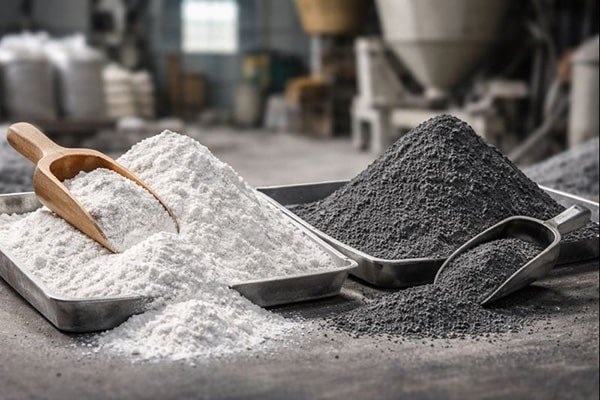
Silica-based materials play a critical role in construction, refractories, foundry, and industrial manufacturing. Among them, silica flour and silica fume are often confused due to their similar chemical composition. However, they differ significantly in particle size, reactivity, performance, and applications.
This article provides a clear, practical comparison of silica flour vs silica fume, helping engineers, procurement managers, and manufacturers choose the right material for their projects.
What Is Silica Flour?
Silica flour is a finely ground form of natural crystalline quartz (SiO₂), produced by crushing and milling high-purity silica sand or quartz.
Key Properties of Silica Flour
- SiO₂ content: ≥ 99%
- Particle size: typically 5–75 microns
- Structure: crystalline
- Shape: angular
- Reactivity: chemically inert
Common Applications of Silica Flour
Silica flour is mainly used as a functional filler, not a reactive material.
Typical industries include:
- Foundry molds and cores
- Glass and ceramic production
- Paints and coatings
- Rubber and plastics
- Refractory castables
- Oil well cement (as a filler)
Main function:
Improve hardness, abrasion resistance, thermal stability, and dimensional control at a relatively low cost.
What Is Silica Fume?
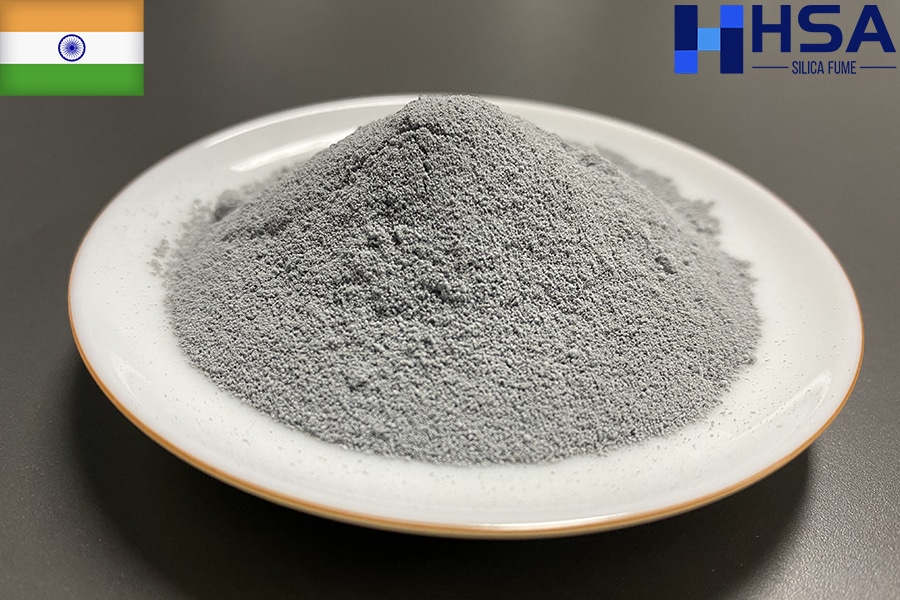
Silica fume, also known as microsilica, is an ultrafine amorphous silica powder collected as a by-product during silicon metal or ferrosilicon alloy production.
It is widely recognized as a high-performance supplementary cementitious material (SCM).
Key Properties of Silica Fume
- SiO₂ content: 85–99%
- Particle size: 0.1–0.3 microns
- Structure: amorphous
- Shape: spherical
- Reactivity: highly pozzolanic
Common Applications of Silica Fume
Silica fume is used where strength and durability are critical:
- High-performance concrete (HPC)
- Ultra-high performance concrete (UHPC)
- Bridge decks and marine structures
- Industrial floors
- Shotcrete and tunnels
- Low-porosity refractory castables
Main function:
Enhance compressive strength, abrasion resistance, chemical resistance, and impermeability.
Silica Flour vs Silica Fume: Side-by-Side Comparison
| Property | Silica Flour | Silica Fume |
|---|---|---|
| Chemical structure | Crystalline | Amorphous |
| Particle size | Micron-level (μm) | Sub-micron (nm) |
| Shape | Angular | Spherical |
| Pozzolanic activity | None | Very high |
| Water demand | Low | High |
| Primary role | Filler / extender | Strength & durability enhancer |
| Typical dosage | 10–40% | 5–10% |
| Cost | Lower | Higher |
Performance Differences in Concrete and Refractories
In Concrete
- Silica flour acts mainly as an inert filler and does not significantly increase strength
- Silica fume reacts with calcium hydroxide, forming additional C-S-H gel, resulting in:
- Higher compressive strength
- Lower permeability
- Improved durability
In Refractory Castables
Both materials are commonly used together:
- Silica flour → improves particle packing and flow
- Silica fume → reduces porosity and enhances hot strength
This combination delivers cost efficiency plus high performance.
Can Silica Flour Replace Silica Fume?
❌ No, they are not interchangeable
- Silica flour cannot replace silica fume in high-strength or high-durability concrete
- Silica fume is not economical as a bulk filler like silica flour
✅ Best practice:
Use silica flour for volume and cost control, and silica fume for performance enhancement.
How to Choose Between Silica Flour and Silica Fume
Choose silica flour if you need:
- Cost-effective filler
- Dimensional stability
- Abrasion resistance
- High-temperature performance without chemical reaction
Choose silica fume if you need:
- High compressive strength
- Low permeability
- Chemical and sulfate resistance
- Long-term durability
Conclusion
While both materials are high in SiO₂, silica flour and silica fume serve fundamentally different purposes. Understanding their differences allows manufacturers and engineers to optimize performance, cost, and durability in concrete, refractory, and industrial applications.
For advanced construction and refractory systems, the right combination of silica flour and silica fume often delivers the best results.